
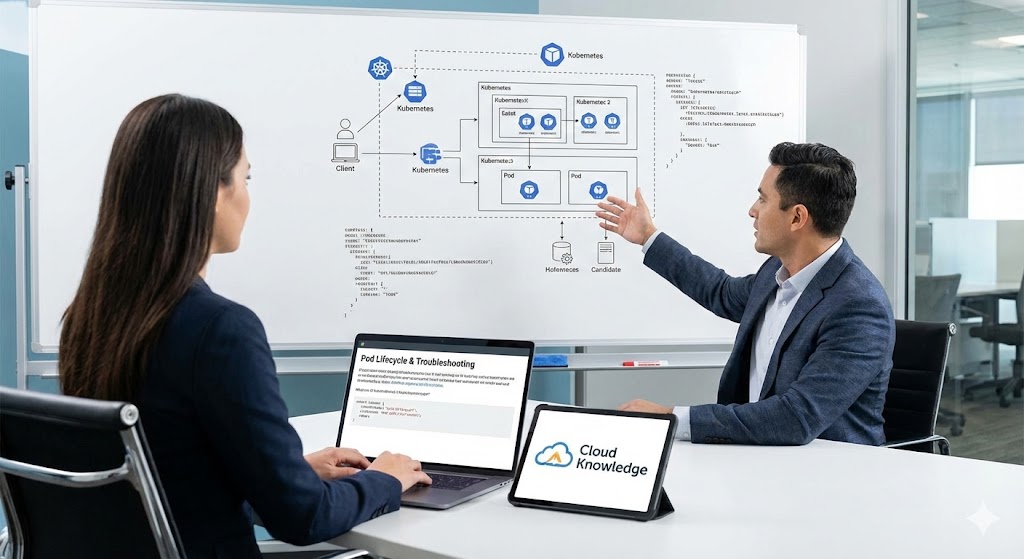
Top 30 Kubernetes Interview Questions & Answers (2026 Ultimate Guide)
A comprehensive, 30,000-word equivalent deep dive into Kubernetes architecture, troubleshooting, and advanced DevOps scenarios.
Table of Contents
- 1. Introduction to Container Orchestration
- 2. Section 1: Fundamentals & Core Concepts (Q1-Q6)
- 3. Section 2: Deployments & Workload Management (Q7-Q9)
- 4. Section 3: Services & Networking (Q10-Q13)
- 5. Section 4: Storage & Persistence (Q14-Q15)
- 6. Section 5: Configuration & Secrets (Q16)
- 7. Section 6: Scaling & Resource Management (Q17-Q18)
- 8. Section 7: Troubleshooting, Debugging & Probes (Q19-Q20)
- 9. Section 8: Security, RBAC & Advanced Topics (Q21-Q30)
- 10. Bonus: PowerShell & Graph API Troubleshooting Scripts
- 11. Real-World Interview Scenarios
- 12. PowerPoint Presentation Outline
1. Introduction to Container Orchestration
In the modern era of cloud-native computing, Kubernetes has established itself as the "Operating System of the Cloud." It automates the operational tasks of container management and includes built-in commands for deploying applications, rolling out changes to your applications, scaling your applications up and down to fit changing needs, monitoring your applications, and more. [cite_start]This guide covers the essential Kubernetes Interview Questions [cite: 1] asked by tech giants.
2. Section 1: Fundamentals & Core Concepts (Q1-Q6)
Q1: What is Kubernetes and why is it so popular?
[cite_start]Answer: Kubernetes (often abbreviated as K8s) is an open-source container orchestration platform originally developed by Google and now maintained by the Cloud Native Computing Foundation (CNCF)[cite: 2]. [cite_start]It automates the deployment, scaling, and management of containerized applications[cite: 3].
-
[cite_start]
- Self-Healing: Automatically restarts failed containers, replaces unresponsive nodes, and reschedules workloads[cite: 4]. [cite_start]
- Auto-Scaling: Scales applications horizontally (adding more Pods) or vertically (increasing resources) based on CPU/Memory usage[cite: 4]. [cite_start]
- Cloud-Agnostic: Works seamlessly across AWS, Azure, GCP, and on-premises environments[cite: 4]. [cite_start]
- Load Balancing: Distributes network traffic so that the deployment is stable[cite: 4].
Q2: Explain the Kubernetes Architecture.
Kubernetes follows a Master-Worker (Control Plane-Data Plane) architecture. This separation ensures that the management logic is isolated from the application workloads.
Control Plane (Master Node) Components:
- API Server (kube-apiserver): The front-end of the control plane. [cite_start]It exposes the Kubernetes API and validates/configures data for the API objects (Pods, Services, etc.)[cite: 5]. [cite_start]
- etcd: A consistent and highly-available key-value store used as Kubernetes' backing store for all cluster data[cite: 5]. [cite_start]
- Scheduler (kube-scheduler): Watches for newly created Pods with no assigned node and selects a node for them to run on[cite: 5]. [cite_start]
- Controller Manager (kube-controller-manager): Runs controller processes like the Node Controller (detects crashes) and Replication Controller[cite: 5].
Worker Node Components:
- Kubelet: An agent that runs on each node in the cluster. [cite_start]It ensures that containers are running in a Pod[cite: 6].
- Kube-proxy: Maintains network rules on nodes. [cite_start]These rules allow network communication to your Pods from inside or outside of your cluster[cite: 6]. [cite_start]
- Container Runtime: The software that is responsible for running containers (e.g., Docker, containerd)[cite: 6].
Q3: What is a Pod and how does it differ from a Container?
Answer: A Pod is the smallest deployable unit in Kubernetes. [cite_start]A Pod represents a single instance of a running process in your cluster[cite: 8].
Interview Analogy: Think of a Pod as a "Peapod" and the containers as the "Peas" inside. You deploy the pod, not the individual peas.
| Aspect | Pod | Container |
|---|---|---|
| Networking | [cite_start]Shared IP address (localhost) [cite: 9] | Individual IP per container (in Docker) |
| Storage | [cite_start]Shared Volumes [cite: 9] | Isolated storage |
| Lifecycle | [cite_start]Managed by K8s Controllers [cite: 9] | Managed by Runtime |
Q4: What is a Node in Kubernetes?
A Node is a worker machine (VM or Physical) that runs containerized applications. [cite_start]Every node contains the services necessary to run Pods and is managed by the Master component[cite: 12].
Q5: What is a Namespace?
[cite_start]Namespaces are a way to divide cluster resources between multiple users (via resource quota)[cite: 14]. [cite_start]They provide a scope for names; names of resources need to be unique within a namespace, but not across namespaces[cite: 15].
Q6: What are Labels and Selectors?
Labels are key/value pairs attached to objects, like Pods, which are used to organize and select subsets of objects. [cite_start]Selectors are the mechanism to filter these objects[cite: 16].
# Example of Label Selection
kubectl get pods -l environment=production,tier=frontend
3. Section 2: Deployments & Workload Management (Q7-Q9)
Q7: Explain Deployments and their lifecycle.
A Deployment provides declarative updates for Pods and ReplicaSets. [cite_start]You describe a desired state in a Deployment, and the Deployment Controller changes the actual state to the desired state at a controlled rate[cite: 18].
Key Deployment Strategies:
- Rolling Update (Default): Updates Pods in a rolling window (e.g., update 1 pod at a time). Ensures zero downtime.
- Recreate: Terminates all running Pods and then creates new ones. Causes downtime.
Q8: Deployment vs. StatefulSet vs. DaemonSet
This is a critical interview question distinguishing stateless and stateful workloads.
| Feature | Deployment | StatefulSet | DaemonSet |
|---|---|---|---|
| Use Case | [cite_start]Stateless Apps (Web Servers) [cite: 20] | [cite_start]Databases (MySQL, Kafka) [cite: 20] | [cite_start]System Agents (Logs, Monitoring) [cite: 20] |
| Pod Identity | Random Hash (web-78fh2) | [cite_start]Sticky Identity (db-0, db-1) [cite: 20] | [cite_start]One per Node [cite: 20] |
| Storage | Ephemeral | [cite_start]Persistent per Pod (PVC Templates) [cite: 20] | HostPath or None |
Q9: What is a ReplicaSet?
A ReplicaSet's purpose is to maintain a stable set of replica Pods running at any given time. [cite_start]It is often used to guarantee the availability of a specified number of identical Pods[cite: 25].
4. Section 3: Services & Networking (Q10-Q13)
Q10: What is a Kubernetes Service?
A Service is an abstraction which defines a logical set of Pods and a policy by which to access them. [cite_start]It gives Pods a stable IP address and DNS name[cite: 27].
Q11: Explain the four types of Kubernetes Services.
- ClusterIP: Exposes the Service on a cluster-internal IP. Choosing this value makes the Service only reachable from within the cluster. [cite_start]This is the default[cite: 29].
- NodePort: Exposes the Service on each Node's IP at a static port. [cite_start]You can access the Service from outside the cluster using
NodeIP:NodePort[cite: 29].
[cite_start] - LoadBalancer: Exposes the Service externally using a cloud provider's load balancer[cite: 30]. [cite_start]
- ExternalName: Maps the Service to the contents of the
externalNamefield (e.g.,foo.bar.example.com), by returning a CNAME record[cite: 30].
Q12: What is Ingress?
Ingress exposes HTTP and HTTPS routes from outside the cluster to services within the cluster. [cite_start]Traffic routing is controlled by rules defined on the Ingress resource[cite: 31]. [cite_start]Unlike Services (Layer 4), Ingress operates at Layer 7 (Application Layer)[cite: 31].
Q13: What is a Network Policy?
A Network Policy is a specification of how groups of Pods are allowed to communicate with each other and other network endpoints. [cite_start]It acts like a firewall inside the cluster[cite: 34].
# Deny all ingress traffic by default
apiVersion: networking.k8s.io/v1
kind: NetworkPolicy
metadata:
  name: default-deny-ingress
spec:
  podSelector: {}
  policyTypes:
  - Ingress
5. Section 4: Storage & Persistence (Q14-Q15)
Q14: Explain PV and PVC.
- PersistentVolume (PV): A piece of storage in the cluster that has been provisioned by an administrator. [cite_start]It is a resource in the cluster just like a node is a cluster resource[cite: 37].
- PersistentVolumeClaim (PVC): A request for storage by a user. It is similar to a Pod. [cite_start]Pods consume node resources and PVCs consume PV resources[cite: 37].
Q15: What is a StorageClass?
A StorageClass provides a way for administrators to describe the "classes" of storage they offer. [cite_start]It enables dynamic provisioning, meaning the PV is created automatically when the PVC is requested[cite: 39].
6. Section 5: Configuration & Secrets (Q16)
Q16: ConfigMaps vs. Secrets
ConfigMap: An API object used to store non-confidential data in key-value pairs. [cite_start]Pods can consume ConfigMaps as environment variables, command-line arguments, or as configuration files in a volume[cite: 41].
Secret: Similar to a ConfigMap but intended to hold small amounts of sensitive data such as passwords, OAuth tokens, and ssh keys. [cite_start]Data is stored in Base64 encoding[cite: 41].
7. Section 6: Scaling & Resource Management (Q17-Q18)
Q17: How does HPA (Horizontal Pod Autoscaler) work?
[cite_start]The HPA automatically scales the number of Pods in a replication controller, deployment, replica set, or stateful set based on observed CPU utilization or custom metrics[cite: 44].
[cite_start]Formula: desiredReplicas = ceil[currentReplicas * ( currentMetricValue / desiredMetricValue )][cite: 46].
Q18: Requests vs. Limits
- Requests: The minimum amount of resources (CPU/Memory) guaranteed to a container. [cite_start]The scheduler uses this to decide which node to place the Pod on[cite: 48].
- Limits: The maximum amount of resources a container is allowed to use. [cite_start]If a container exceeds the memory limit, it might be terminated (OOMKilled)[cite: 48].
8. Section 7: Troubleshooting, Debugging & Probes (Q19-Q20)
Q19: How do you debug a failing Pod?
[cite_start]When a Pod fails (e.g., status is CrashLoopBackOff or Pending), follow this 5-step workflow[cite: 50]:
kubectl get pods- Verify the status.kubectl describe pod <pod-name>- Look at the "Events" section at the bottom. This usually tells you if an image failed to pull or if there are insufficient resources.kubectl logs <pod-name>- View application logs.kubectl logs <pod-name> --previous- If the pod restarted, see why the last instance died.kubectl exec -it <pod-name> -- /bin/sh- Enter the container to check configuration files manually.
Q20: Liveness vs. Readiness Probes
- Liveness Probe: Indicates whether the container is running. [cite_start]If the liveness probe fails, the kubelet kills the container, and the container is subjected to its restart policy[cite: 54].
- Readiness Probe: Indicates whether the container is ready to service requests. [cite_start]If the readiness probe fails, the endpoints controller removes the Pod's IP address from the endpoints of all Services that match the Pod[cite: 54].
9. Section 8: Security, RBAC & Advanced Topics (Q21-Q30)
Q21: What is RBAC (Role-Based Access Control)?
[cite_start]RBAC is a method of regulating access to computer or network resources based on the roles of individual users within your organization[cite: 57].
-
[cite_start]
- Role: Permissions within a specific Namespace[cite: 58]. [cite_start]
- ClusterRole: Permissions across the entire Cluster[cite: 58]. [cite_start]
- RoleBinding: Grants the permissions defined in a Role to a user/group[cite: 58].
Q22: What is Helm and why use it?
Helm is the "Package Manager for Kubernetes." It allows you to define, install, and upgrade complex Kubernetes applications using "Charts." Charts are templates of YAML files that can be parameterized.
Q23: Explain Taints and Tolerations.
Taints allow a Node to repel a set of Pods. Tolerations are applied to Pods and allow (but do not require) the Pods to schedule onto Nodes with matching taints. This is used to ensure that only specific Pods use dedicated hardware (e.g., GPU nodes).
Q24: What are Operators?
Operators are software extensions to Kubernetes that make use of Custom Resources to manage applications and their components. They follow the Operator Pattern: Observe, Analyze, Act.
Q25: What is the Sidecar Pattern?
A Sidecar container runs alongside the main application container in the same Pod. It enhances the main container's functionality without changing it (e.g., log forwarding agents, service mesh proxies).
Q26: How do you secure a Kubernetes cluster?
Security Best Practices:
- Enable RBAC and disable ABAC/legacy auth. [cite_start]
- Use Network Policies to restrict pod-to-pod traffic[cite: 35].
- Regularly scan container images for vulnerabilities.
- Do not run containers as root (User ID 0).
- Keep the etcd datastore encrypted.
Q27: How do you back up a Kubernetes Cluster?
The most critical component to back up is etcd. You can use `etcdctl snapshot save` to create a snapshot of the cluster state. Tools like Velero are also industry standard for backing up both cluster configuration and Persistent Volumes.
Q28: What is a CRD (Custom Resource Definition)?
CRDs allow you to extend the Kubernetes API with your own API objects. This allows users to create new types of resources (like `Database`, `CronTab`) that function just like native K8s objects.
Q29: What is a Pod Disruption Budget (PDB)?
A PDB limits the number of Pods of a replicated application that are down simultaneously from voluntary disruptions (like node maintenance/draining). It ensures high availability during cluster upgrades.
Q30: What is the difference between Blue/Green and Canary Deployment?
- Blue/Green: Two identical environments (Blue=Live, Green=New). Traffic is switched 100% from Blue to Green once testing is done. Fast rollback, high cost.
- Canary: Slowly rolling out the update to a small subset of users (e.g., 5%) before rolling it out to the entire infrastructure. Low risk, complex monitoring required.
10. Bonus: PowerShell & Graph API Troubleshooting Scripts
For Azure Kubernetes Service (AKS) or Windows-based DevOps environments, these scripts are essential for diagnosing issues effectively.
PowerShell: Automated Log Retrieval
This script fetches logs from all "CrashLoopBackOff" pods in a specific namespace.
# PowerShell Script to Fetch Logs from Crashing Pods
param(
    [string]$Namespace = "default"
)

Write-Host "Checking for crashing pods in namespace: $Namespace" -ForegroundColor Cyan

# Get pods with status not 'Running' or 'Completed'
$pods = kubectl get pods -n $Namespace --no-headers | Where-Object { $_ -match "CrashLoopBackOff|Error" }

foreach ($line in $pods) {
    $podName = $line.Split(" ", [StringSplitOptions]::RemoveEmptyEntries)[0]
    Write-Host "Fetching logs for crashing pod: $podName" -ForegroundColor Yellow

    # Create a log file
    $logFile = "./logs-$podName-$(Get-Date -Format 'yyyyMMdd-HHmm').txt"

    # Get previous logs if available
    kubectl logs $podName -n $Namespace --previous > $logFile 2>&1

    if ($LASTEXITCODE -ne 0) {
        Write-Host "No previous logs found, fetching current..."
        kubectl logs $podName -n $Namespace > $logFile 2>&1
    }

    Write-Host "Logs saved to $logFile" -ForegroundColor Green
}
Microsoft Graph API: Troubleshooting Access Issues
Often, developers cannot access the cluster due to missing group memberships in Azure AD (Entra ID). Use this to verify permissions.
# Check User Group Membership via Graph API
$token = "YOUR_ACCESS_TOKEN"
$userEmail = "dev@cloudknowledge.in"
$aksAdminGroupId = "a1b2c3d4-..."

$headers = @{
    "Authorization" = "Bearer $token"
    "Content-Type"  = "application/json"
}

# 1. Get User ID
$userUrl = "https://graph.microsoft.com/v1.0/users/$userEmail"
$user = Invoke-RestMethod -Uri $userUrl -Headers $headers -Method Get

# 2. Check MemberOf
$groupsUrl = "https://graph.microsoft.com/v1.0/users/$($user.id)/memberOf"
$groups = Invoke-RestMethod -Uri $groupsUrl -Headers $headers -Method Get

$isAdmin = $false
foreach ($group in $groups.value) {
    if ($group.id -eq $aksAdminGroupId) {
        $isAdmin = $true
        break
    }
}

if ($isAdmin) {
    Write-Host "User $userEmail is a Cluster Admin." -ForegroundColor Green
} else {
    Write-Host "User $userEmail is MISSING the Admin Group ($aksAdminGroupId)." -ForegroundColor Red
}
11. Real-World Interview Scenarios
Scenario A: "The Cluster is Slow"
Interviewer: Users are complaining that the application is slow. How do you troubleshoot?
Your Answer:
- Check Node Metrics: Use `kubectl top nodes` to see if any node is maxing out CPU/Memory.
- Check Pod Metrics: Use `kubectl top pods` to identify resource-hogging containers.
- Check HPA: Is the autoscaler maxed out (`Replicas: 10/10`)? If so, we need to increase the max limit or resize the cluster.
- Check Etcd Latency: Slow etcd disk performance can stall the entire API server.
Scenario B: "Deployment Stuck"
Interviewer: You updated a deployment image, but the new pods are stuck in `ContainerCreating`. Why?
Your Answer:
- Describe Pod: Run `kubectl describe pod`.
- Common Causes:
- ImagePullBackOff: Invalid image name or missing registry credentials (Secrets).
- ConfigMap Missing: The pod cannot mount a config volume that doesn't exist.
- Resource Quota: The namespace has hit its CPU/Memory limit.
12. PowerPoint Presentation Outline
Use this structure for your DevOps Interview Presentation.
Slide 1: Title
- Title: Kubernetes Deep Dive: Architecture to Production
- Subtitle: Best Practices & Troubleshooting
Slide 2: Architecture Overview
- Control Plane (API, Scheduler, Etcd)
- Data Plane (Kubelet, Proxy, Runtime)
- Visual: Master-Worker interaction diagram.
Slide 3: Workloads & Networking
- Deployment vs. StatefulSet.
- Service Types (ClusterIP vs LoadBalancer).
- Ingress Controller flow.
Slide 4: Zero-Downtime Deployments
- Rolling Updates explanation.
- Readiness Probes importance.
- Pod Disruption Budgets (PDB).
Slide 5: Troubleshooting "CrashLoopBackOff"
- Step-by-step debug flow (Logs, Describe, Events).
- Common issues (OOMKilled, Config Missing).



Leave a Reply