

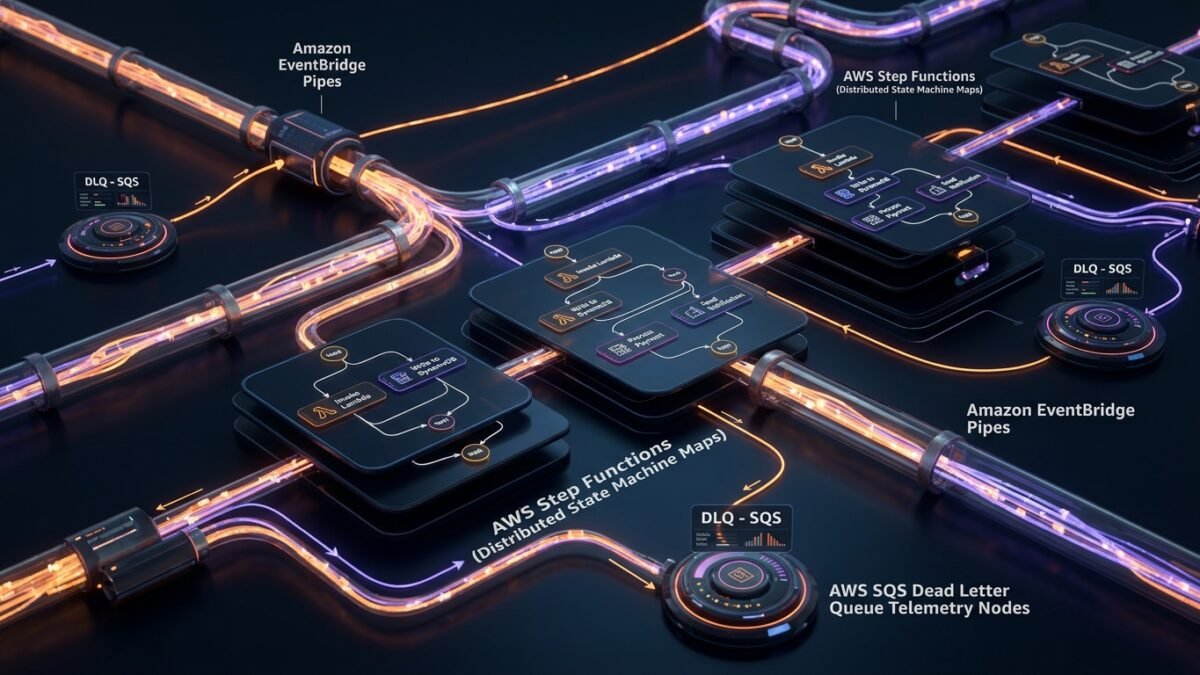
Serverless event-driven architectures are the standard for modern cloud applications, offering horizontal scalability and pay-per-use economics. However, under sudden burst traffic—such as financial market volatility, e-commerce flash sales, or IoT sensor surges—poorly architected serverless pipelines fail catastrophically. Common failure modes include downstream database connection pool exhaustion, Lambda concurrency throttling, unhandled poison-pill messages, and silent message dropping due to misconfigured Dead-Letter Queues (DLQ). Achieving guaranteed zero-data-loss resiliency requires moving beyond ad-hoc Lambda-to-Lambda chains. By integrating Amazon EventBridge Pipes, AWS Step Functions Distributed Maps, SQS FIFO buffer isolation, and automated CloudWatch redrive telemetry, enterprise architects construct resilient, self-healing event pipelines capable of processing millions of transactions without losing a single byte. In this guide, we engineer a resilient production event pipeline.
1. The Problem: How Serverless Pipelines Fail Under Extreme Load
In distributed event-driven systems, operational failures rarely stem from compute limitations; they stem from asynchronous decoupling failures:
- Lambda Throttling & Concurrency Exhaustion: An upstream DynamoDB stream or Kinesis stream spikes to 50,000 events/sec. If unthrottled Lambda consumers scale rapidly, they consume the entire account concurrency pool (default 1,000), causing unrelated critical services across the AWS account to fail.
- Poison-Pill Message Deadlocks: A single malformed JSON payload crashes the processing function. In a FIFO queue or streaming consumer, this single corrupt record halts the entire partition, stalling all subsequent transactions until the message retention period expires.
- Unmonitored Dead-Letter Queues: Teams route failed events to SQS Dead-Letter Queues (DLQs) but neglect automated alerting or replay mechanisms, allowing thousands of business-critical orders to sit unaddressed until permanently deleted by the 14-day SQS retention limit.
| Resiliency Factor | Standard Lambda-Chained Architecture | Zero-Data-Loss Resilient Architecture |
|---|---|---|
| Ingestion Decoupling | Direct API Gateway to Lambda invocation | Amazon SQS FIFO Buffer + EventBridge Pipes Filtering |
| Batch Transformation | Custom Python/Node.js batch loop in Lambda | AWS Step Functions Distributed Map (Up to 10,000 parallel workers) |
| Poison-Pill Isolation | Entire batch fails and retries repeatedly | Bisect-on-function-error + Automated SQS DLQ Extraction |
| Concurrency Guardrails | Unconstrained autoscaling drains DB connections | Reserved Concurrency + Step Functions MaxConcurrency throttling |
| Failure Recovery & Replay | Manual CLI scripts / one-off custom code | Automated SQS Redrive to Source Queue + EventBridge Scheduler |
2. Architectural Blueprint: The Zero-Data-Loss Pipeline Topology
The enterprise pipeline architecture is engineered around four decoupled layers:
- Ingestion & Buffer Plane: Streaming inputs (Amazon Kinesis or SQS FIFO) receive transactions. Amazon EventBridge Pipes acts as the point-to-point conduit, applying native JSON Path filters to discard benign duplicates before invoking downstream compute, slashing Lambda invocation bills by up to 60%.
- Batch Orchestration Plane: EventBridge Pipes hands clean batches directly to AWS Step Functions. The state machine utilizes Distributed Map in
DISTRIBUTEDmode, dividing massive datasets into parallel item batches with precisely controlled concurrency limits to protect downstream RDS Aurora Postgres connection pools. - Dead-Letter & Quarantine Plane: If an individual record fails after maximum retry attempts, Step Functions isolates the record, enriches it with error stack traces, and places it into an Amazon SQS Dead-Letter Queue configured with Amazon S3 payload archiving for payloads exceeding 256KB.
- Telemetry & Automated Replay Plane: Amazon CloudWatch Contributor Insights monitors the DLQ. If queue depth exceeds zero, an automated alarm triggers an EventBridge Scheduler task to inspect the payload, notify the On-Call SecOps engineer via Slack/SNS, and initiate automated SQS Redrive once the root cause is resolved.
3. Production Infrastructure as Code: AWS CloudFormation / CDK Template
The following CloudFormation template deploys the EventBridge Pipe, SQS FIFO Queue, Dead-Letter Queue, and Step Functions Distributed Map infrastructure:
AWSTemplateFormatVersion: '2010-09-09'
Description: 'Enterprise Zero-Data-Loss Serverless Event Pipeline'

Resources:
  # 1. Primary Dead-Letter Queue (DLQ)
  ProcessingDLQ:
    Type: AWS::SQS::Queue
    Properties:
      QueueName: 'orders-processing-dlq.fifo'
      FifoQueue: true
      MessageRetentionPeriod: 1209600 # 14 Days
      KmsMasterKeyId: 'alias/aws/sqs'

  # 2. Main High-Throughput Ingestion Queue
  IngestionQueue:
    Type: AWS::SQS::Queue
    Properties:
      QueueName: 'orders-ingestion-queue.fifo'
      FifoQueue: true
      ContentBasedDeduplication: true
      VisibilityTimeout: 300
      RedrivePolicy:
        deadLetterTargetArn: !GetAtt ProcessingDLQ.Arn
        maxReceiveCount: 3
      KmsMasterKeyId: 'alias/aws/sqs'

  # 3. IAM Role for EventBridge Pipes
  EventBridgePipeRole:
    Type: AWS::IAM::Role
    Properties:
      AssumeRolePolicyDocument:
        Version: '2012-10-17'
        Statement:
          - Effect: Allow
            Principal:
              Service: pipes.amazonaws.com
            Action: 'sts:AssumeRole'
      Policies:
        - PolicyName: PipeExecutionPolicy
          PolicyDocument:
            Version: '2012-10-17'
            Statement:
              - Effect: Allow
                Action:
                  - 'sqs:ReceiveMessage'
                  - 'sqs:DeleteMessage'
                  - 'sqs:GetQueueAttributes'
                Resource: !GetAtt IngestionQueue.Arn
              - Effect: Allow
                Action: 'states:StartExecution'
                Resource: !Ref OrderProcessingStateMachine

  # 4. Amazon EventBridge Pipe Definition
  OrderProcessingPipe:
    Type: AWS::Pipes::Pipe
    Properties:
      Name: 'orders-ingestion-to-stepfunctions-pipe'
      RoleArn: !GetAtt EventBridgePipeRole.Arn
      Source: !GetAtt IngestionQueue.Arn
      SourceParameters:
        SqsQueueParameters:
          BatchSize: 10
      Target: !Ref OrderProcessingStateMachine
      TargetParameters:
        StepFunctionStateMachineParameters:
          InvocationType: FIRE_AND_FORGET

  # 5. Step Functions State Machine with Distributed Map
  OrderProcessingStateMachine:
    Type: AWS::StepFunctions::StateMachine
    Properties:
      StateMachineName: 'Enterprise-Order-Processor'
      RoleArn: !GetAtt StateMachineExecutionRole.Arn
      DefinitionString: !Sub |
        {
          "Comment": "Zero-Data-Loss Order Batch Processor",
          "StartAt": "ProcessBatchDistributed",
          "States": {
            "ProcessBatchDistributed": {
              "Type": "Map",
              "ItemProcessor": {
                "ProcessorConfig": {
                  "Mode": "DISTRIBUTED",
                  "ExecutionType": "STANDARD"
                },
                "StartAt": "ValidateAndPersist",
                "States": {
                  "ValidateAndPersist": {
                    "Type": "Task",
                    "Resource": "arn:aws:states:::lambda:invoke",
                    "Parameters": {
                      "FunctionName": "arn:aws:lambda:${AWS::Region}:${AWS::AccountId}:function:persist-order-func",
                      "Payload.$": "$"
                    },
                    "Retry": [
                      {
                        "ErrorEquals": ["Lambda.ServiceException", "Lambda.TooManyRequestsException"],
                        "IntervalSeconds": 2,
                        "MaxAttempts": 3,
                        "BackoffRate": 2.0
                      }
                    ],
                    "Catch": [
                      {
                        "ErrorEquals": ["States.ALL"],
                        "Next": "RouteToQuarantineDLQ"
                      }
                    ],
                    "End": true
                  },
                  "RouteToQuarantineDLQ": {
                    "Type": "Task",
                    "Resource": "arn:aws:states:::sqs:sendMessage",
                    "Parameters": {
                      "QueueUrl": "${ProcessingDLQ}",
                      "MessageBody.$": "$",
                      "MessageGroupId": "QuarantinedRecords"
                    },
                    "End": true
                  }
                }
              },
              "MaxConcurrency": 50,
              "End": true
            }
          }
        }
4. Automated DLQ Monitoring & Redrive Telemetry
Deploying a Dead-Letter Queue without continuous monitoring is a severe compliance violation. The CloudWatch Alarm below triggers instantly if any failed transactions enter the quarantine queue:
  # CloudWatch Alarm for Immediate DLQ Alerting
  DLQMessageAlarm:
    Type: AWS::CloudWatch::Alarm
    Properties:
      AlarmName: 'CRITICAL-Serverless-DLQ-Messages-Detected'
      AlarmDescription: 'Fires when messages appear in the serverless processing DLQ'
      MetricName: 'ApproximateNumberOfMessagesVisible'
      Namespace: 'AWS/SQS'
      Dimensions:
        - Name: QueueName
          Value: !GetAtt ProcessingDLQ.QueueName
      Statistic: Maximum
      Period: 60
      EvaluationPeriods: 1
      Threshold: 1
      ComparisonOperator: GreaterThanOrEqualToThreshold
      TreatMissingData: notBreaching
5. SQS Redrive Automation via AWS CLI
Once downstream service outages (e.g., database network partitions) are resolved, use the AWS CLI to initiate an automated, in-flight redrive of quarantined records back to the source ingestion queue without manual scripting:
# 1. Start Dead-Letter Queue Redrive Task
aws sqs start-message-move-task   --source-arn "arn:aws:sqs:us-east-1:123456789012:orders-processing-dlq.fifo"   --destination-arn "arn:aws:sqs:us-east-1:123456789012:orders-ingestion-queue.fifo"   --max-number-of-messages-per-second 50

# 2. Monitor Redrive Task Progress
aws sqs list-message-move-tasks   --source-arn "arn:aws:sqs:us-east-1:123456789012:orders-processing-dlq.fifo"
5. Event-Driven Cost Optimization: Lambda Polling vs. EventBridge Pipes
Before EventBridge Pipes, integrating streaming message queues (like SQS or DynamoDB Streams) with event-driven architectures required either running continuous Lambda polling functions or provisioned consumer instances. This legacy design incurred significant financial and architectural waste:
- Empty Poll Charges: Lambda event source mapping continuously polls empty SQS queues, generating millions of billable API requests per month even during idle periods.
- Compute Waste on Discarded Events: If only 5% of events in an SQS queue require processing (e.g., only orders marked “STATUS=CRITICAL”), a standard Lambda consumer must spin up, parse the entire batch, discard 95% of records, and terminate—wasting compute cycles.
- The Pipes Advantage: EventBridge Pipes handles polling at the AWS infrastructure level with zero compute charges for empty polls. Its native JSONPath filtering discards unwanted messages before compute is invoked, reducing serverless execution costs by up to 60-80%.
6. Step Functions Distributed Map: Tolerating Partial Batch Failures
In high-throughput enterprise batch processing, a batch of 50,000 transactions may contain 5 malformed records. Failing the entire batch due to 5 records destroys SLA commitments. AWS Step Functions Distributed Map provides granular error resilience configurations:
ToleratedFailurePercentage: Allows the execution to succeed as long as the failure rate remains below a defined threshold (e.g.,0.1%).ToleratedFailureCount: Allows an exact number of records to fail while the overall map run reports success.- Individual Item Quarantine: Using the
Catchblock within the item processor, failed records are routed directly to an SQS quarantine queue with error context, while the remaining 49,995 valid records commit successfully to production databases.
8. Complete AWS CDK TypeScript Infrastructure Definition
For cloud platform teams utilizing Infrastructure as Code in TypeScript, the following AWS Cloud Development Kit (CDK v2) construct deploys the complete, self-healing serverless pipeline:
import * as cdk from 'aws-cdk-lib';
import * as sqs from 'aws-cdk-lib/aws-sqs';
import * as pipes from 'aws-cdk-lib/aws-pipes';
import * as sfn from 'aws-cdk-lib/aws-stepfunctions';
import * as iam from 'aws-cdk-lib/aws-iam';
import { Construct } from 'constructs';

export class ResilientServerlessPipelineStack extends cdk.Stack {
  constructor(scope: Construct, id: string, props?: cdk.StackProps) {
    super(scope, id, props);

    // 1. Dead-Letter Queue (DLQ) for Poison-Pill Quarantine
    const dlq = new sqs.Queue(this, 'ProcessingDLQ', {
      fifo: true,
      queueName: 'orders-quarantine-dlq.fifo',
      retentionPeriod: cdk.Duration.days(14),
      encryption: sqs.QueueEncryption.KMS_MANAGED,
    });

    // 2. High-Throughput SQS FIFO Ingestion Buffer
    const ingestionQueue = new sqs.Queue(this, 'IngestionQueue', {
      fifo: true,
      queueName: 'orders-ingestion-buffer.fifo',
      contentBasedDeduplication: true,
      visibilityTimeout: cdk.Duration.minutes(5),
      deadLetterQueue: {
        maxReceiveCount: 3,
        queue: dlq,
      },
    });

    // 3. Step Functions Distributed Map State Machine
    const mapState = new sfn.CustomState(this, 'DistributedMapProcessor', {
      stateJson: {
        Type: 'Map',
        ItemProcessor: {
          ProcessorConfig: { Mode: 'DISTRIBUTED', ExecutionType: 'STANDARD' },
          StartAt: 'PersistOrder',
          States: {
            PersistOrder: {
              Type: 'Task',
              Resource: 'arn:aws:states:::lambda:invoke',
              End: true,
            },
          },
        },
        MaxConcurrency: 50,
        ToleratedFailurePercentage: 0.1,
      },
    });

    const stateMachine = new sfn.StateMachine(this, 'OrderProcessingEngine', {
      definition: mapState,
      timeout: cdk.Duration.hours(1),
    });

    // 4. Amazon EventBridge Pipe with SQS Source and Step Functions Target
    const pipeRole = new iam.Role(this, 'EventBridgePipeRole', {
      assumedBy: new iam.ServicePrincipal('pipes.amazonaws.com'),
    });

    ingestionQueue.grantConsumeMessages(pipeRole);
    stateMachine.grantStartExecution(pipeRole);

    new pipes.CfnPipe(this, 'OrderEventBridgePipe', {
      name: 'orders-stream-to-sfn-pipe',
      roleArn: pipeRole.roleArn,
      source: ingestionQueue.queueArn,
      target: stateMachine.stateMachineArn,
      targetParameters: {
        stepFunctionStateMachineParameters: {
          invocationType: 'FIRE_AND_FORGET',
        },
      },
    });
  }
}
7. Comprehensive AWS Serverless Resiliency Diagnostic Scenarios
| Failure Condition | Root Cause Analysis | Architecture Fix & Remediation |
|---|---|---|
Lambda.TooManyRequestsException |
Downstream Lambda consumer exceeded account reserved concurrency limit during traffic burst. | Configure ReservedConcurrentExecutions on the processing Lambda. In Step Functions Distributed Map, set MaxConcurrency: 50 to enforce a strict upper bound on parallel executions. |
KMS Access Denied on SQS Ingestion |
EventBridge Pipe role lacks kms:Decrypt or kms:GenerateDataKey on the customer-managed KMS key encrypting the queue. |
Update the AWS KMS key policy to explicitly grant pipes.amazonaws.com permission to use the key for cryptographic envelope operations. |
EventBridge Pipe Stalled on FIFO Partition |
A poison-pill message failed processing and reached the maximum retry limit, but no DLQ was configured on the pipe source. | Always attach a Dead-Letter Queue directly to the EventBridge Pipe source parameters or enable MaximumRetryAttempts with automatic failure discard. |
9. Automated Self-Healing DLQ Redrive Lambda Function
To eliminate manual CLI execution during disaster recovery, deploy an automated serverless self-healing function that listens to CloudWatch Dead-Letter Queue alarms and safely replays quarantined transactions:
import boto3
import os
import json
import logging

logger = logging.getLogger()
logger.setLevel(logging.INFO)
sqs = boto3.client('sqs')

def lambda_handler(event, context):
    source_dlq_arn = os.environ['SOURCE_DLQ_ARN']
    dest_queue_arn = os.environ['DEST_QUEUE_ARN']

    logger.info(f"Starting automated SQS Redrive task from {source_dlq_arn} to {dest_queue_arn}")

    response = sqs.start_message_move_task(
        SourceArn=source_dlq_arn,
        DestinationArn=dest_queue_arn,
        MaxNumberOfMessagesPerSecond=50
    )

    task_handle = response.get('TaskHandle')
    logger.info(f"Redrive task initiated successfully. TaskHandle: {task_handle}")
    return {"status": "SUCCESS", "taskHandle": task_handle}
10. Enterprise AWS Serverless Resiliency FAQ
Q1: Why choose Amazon EventBridge Pipes instead of standard SQS Lambda Event Source Mapping (ESM)?
While SQS ESM invokes Lambda directly, EventBridge Pipes introduces native enrichment (calling API Destinations or Lambda before target invocation) and built-in filtering at the AWS infrastructure level without invoking compute. Furthermore, Pipes connects directly to Step Functions, Kinesis, or CloudWatch without requiring an intermediary Lambda function, reducing both architectural surface area and operating costs.
Q2: How do Step Functions Distributed Maps maintain high throughput without exhausting database connections?
The MaxConcurrency attribute on the Distributed Map state enforces a strict hard ceiling on the number of parallel item processors active at any given millisecond. For example, setting MaxConcurrency: 40 ensures that regardless of whether the input file contains 1,000 or 1,000,000 records, no more than 40 database connections will ever be opened simultaneously against Amazon Aurora.
Q3: What happens to messages in the SQS FIFO Ingestion Queue if the Step Functions execution fails?
Because the queue is configured with a 5-minute Visibility Timeout and a maxReceiveCount: 3, an unexpected failure allows the message to return to the queue for retry. If the failure persists across all 3 attempts, SQS automatically isolates the message to the Dead-Letter Queue (DLQ), preserving the original message body, message attributes, and failure context for forensic redrive.
6. Architectural Summary & Production Checklist
- Decouple with EventBridge Pipes: Filter non-critical events upstream to conserve compute concurrency and reduce infrastructure costs.
- Bound Concurrency via Distributed Maps: Set
MaxConcurrencylimits on Step Functions to prevent database connection starvation. - Mandate FIFO Queues with Poison-Pill Isolation: Use
Catchblocks in Step Functions to isolate corrupt payloads without halting the batch. - Automate DLQ Redrive Workflows: Integrate CloudWatch Alarms and SQS Message Move Tasks to ensure zero data loss during systemic outages.
Recommended Hardware & Reference Architecture Literature
Tested tools and authoritative documentation to implement the architectures covered in this lab: