

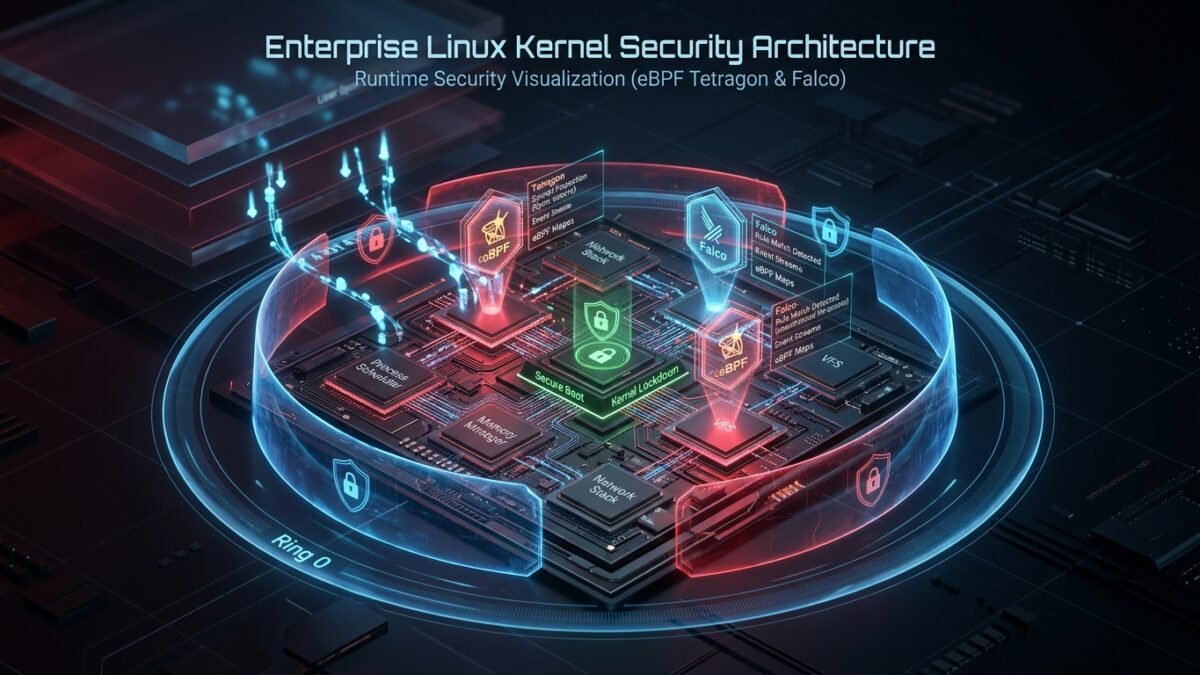
For decades, Linux security monitoring depended on user-space auditing daemons (auditd), static Seccomp filters, and intrusive kernel modules. In modern containerized and cloud-native environments, user-space monitoring suffers from high CPU overhead, dropped audit logs under heavy I/O, and susceptibility to evasion attacks. The rise of Extended Berkeley Packet Filter (eBPF) technology fundamentally reinvents Linux runtime defense. By running sandboxed, verifier-checked byte code directly inside the Linux kernel (Ring 0), tools like Cilium Tetragon and Sysdig Falco detect and actively terminate unauthorized system calls, container escapes, and privilege escalation exploits in real time. In this technical deep-dive, we architect and deploy an enterprise Linux runtime defense framework powered by eBPF Tetragon and Falco.
1. The Problem: The Blind Spots of Legacy Linux Auditing
Legacy auditing mechanisms like auditd and ptrace-based intrusion detection introduce critical vulnerabilities when deployed at scale:
- Time-of-Check to Time-of-Use (TOCTOU) Exploits: User-space monitoring tools inspect system call arguments after the kernel has accepted the pointer, allowing sophisticated malware to swap argument memory asynchronously and evade detection.
- Catastrophic Performance Degradation: Hooking every
read,write, andexecvesystem call via user-spaceauditdgenerates severe context-switching overhead, frequently consuming 30% to 50% of total host CPU resources. - Kernel Exploit Invisibility: Zero-day exploits manipulating kernel page tables or abusing privilege primitives (e.g., Dirty COW, Dirty Pipe, OverlayFS vulnerabilities) execute before user-space loggers can process the event.
| Operational Metric | Legacy Linux auditd |
eBPF Tetragon / Falco Architecture |
|---|---|---|
| Execution Domain | User Space (Context switch for each event) | Kernel Space (Ring 0 sandboxed execution) |
| CPU & I/O Overhead | High (Severe bottlenecks under I/O load) | Negligible (< 1.5% CPU overhead in production) |
| TOCTOU Evasion Defense | Vulnerable to memory argument swapping | Immune (Inspects arguments directly within kernel memory) |
| Enforcement Action | Passive logging only (Cannot kill syscall in-flight) | Active Enforcement (Synchronously kills offending process / thread) |
| Kubernetes & Cgroup Awareness | Blind to pod, container, and namespace metadata | Native awareness of namespaces, cgroups, and pod labels |
2. Architectural Blueprint: How eBPF Hooks the Linux Kernel
eBPF allows developers to attach custom programs to kernel tracepoints, kprobes, kretprobes, and Linux Security Module (LSM) hooks without modifying kernel source code or loading unvetted kernel modules.
Tetragon vs. Falco: Complementary Defensive Layers
- Cilium Tetragon (In-Kernel Enforcement Engine): Tetragon hooks directly into kernel functions (such as
sys_execve,do_sys_open, and TCP/IP stack hooks). Crucially, Tetragon possesses active enforcement capabilities: when a security rule violation occurs, Tetragon can executesigkilldirectly from the eBPF program, terminating malicious binaries before the kernel returns control to user space. - Falco (Behavioral Anomaly & Rules Engine): Falco captures system call streams via its eBPF driver, enriches the events with container runtime metadata (Docker, CRI-O, Kubernetes), and evaluates complex behavioral rule chains to broadcast high-fidelity alerts to SIEM systems.
3. Production Implementation: Installing & Configuring Tetragon
Step 1: Deploying Tetragon on Enterprise Linux (RHEL 9 / Ubuntu 24.04)
# Verify Kernel supports eBPF and BTF (BPF Type Format)
uname -r
cat /boot/config-$(uname -r) | grep -E "CONFIG_BPF=y|CONFIG_BPF_SYSCALL=y|CONFIG_DEBUG_INFO_BTF=y"

# Install Tetragon Standalone Daemon via Official Repository
curl -fsSL https://github.com/cilium/tetragon/releases/latest/download/tetragon-linux-amd64.tar.gz | tar -xz -C /usr/local/bin

# Start Tetragon Systemd Service
systemctl enable --now tetragon
Step 2: Writing a TracingPolicy to Detect Privilege Escalation and SSH Key Injection
Tetragon uses declarative Kubernetes Custom Resource Definitions (CRDs) or YAML files to configure in-kernel TracingPolicies. The following policy monitors unauthorized modifications to /root/.ssh/authorized_keys and terminates the offending process instantly:
apiVersion: cilium.io/v1alpha1
kind: TracingPolicy
metadata:
  name: block-ssh-backdoor-injection
spec:
  kprobes:
    - call: "sys_openat"
      syscall: true
      args:
        - index: 0
          type: "int"
        - index: 1
          type: "string" # File path being opened
        - index: 2
          type: "int"    # Open flags
      selectors:
        - matchArgs:
            - index: 1
              operator: "Prefix"
              values:
                - "/root/.ssh"
                - "/home/*/.ssh"
            - index: 2
              operator: "Mask"
              values:
                - "0x0002" # O_RDWR
                - "0x0042" # O_CREAT | O_RDWR
                - "0x0200" # O_TRUNC
          matchActions:
            - action: Sigkill # Instantly kill the malicious process in the kernel
            - action: Post    # Emit structured JSON audit log
Step 3: Deploying Falco for Container Anomaly Detection
Install Falco using the modern modern eBPF driver:
# Add Falco Helm Repository
helm repo add falcosecurity https://falcosecurity.github.io/charts
helm repo update

# Install Falco using Modern eBPF Engine
helm install falco falcosecurity/falco   --set driver.kind=modern_ebpf   --set tty=true   --namespace falco-system --create-namespace
Step 4: Writing Custom Falco Rules for Reverse Shell Detection
# Custom Rule: Detect Interactive Shells Spawned in Production Containers
- rule: Container Reverse Shell Spawned
  desc: Detects interactive bash/sh spawned from web server processes
  condition: >
    spawned_process and container and
    proc.name in (bash, sh, zsh, ksh) and
    proc.pname in (nginx, httpd, python, node, java, ruby)
  output: >
    CRITICAL: Interactive shell spawned in container
    (user=%user.name container_id=%container.id image=%container.image.repository
     process=%proc.cmdline parent=%proc.pname)
  priority: CRITICAL
  tags: [security, attack, mitre_execution]
4. Troubleshooting & Kernel Diagnostic Playbook
| Error Message | Diagnostic Root Cause | Resolution & Kernel Fix |
|---|---|---|
bpf_prog_load failed: Permission denied / Verifier error |
eBPF verifier rejected program due to unbounded loop or memory bounds violation. | Ensure kernel version is 5.15+ (LTS). Verify BTF debugging symbols exist at /sys/kernel/btf/vmlinux. |
Lost events detected in perf buffer |
Ring buffer saturated due to high syscall event frequency. | Refine policy selectors to filter out high-volume benign processes (e.g., Prometheus node-exporter, systemd-journald). |
BPF LSM disabled in kernel |
Kernel boot parameters do not include bpf in the LSM initialization string. |
Edit /etc/default/grub, append lsm=lockdown,capability,landlock,yama,bpf, run update-grub and reboot. |
5. Frequently Asked Questions (FAQ)
Q1: Can an attacker running as root disable or tamper with an active eBPF security program?
If an attacker achieves root privileges and the system does not enforce Kernel Lockdown or secure boot, they could theoretically unload eBPF programs via bpf() system calls. To prevent this, enterprise security architectures enforce Linux Kernel Lockdown mode (lockdown=confidentiality) and leverage Tetragon to monitor and block any unvetted sys_bpf invocations.
Q2: Does eBPF replace SELinux or AppArmor?
No. eBPF enhances and complements SELinux/AppArmor. While SELinux provides static Mandatory Access Control (MAC) policies, eBPF provides dynamic runtime telemetry, real-time behavioral tracing, and customizable in-kernel enforcement policies that adapt to container lifecycles.
5. Deep-Dive: Memory Management in eBPF Ring Buffers
High-throughput Linux hosts generating tens of thousands of system calls per second require careful tuning of eBPF memory buffers. Modern eBPF tools use BPF_MAP_TYPE_RINGBUF rather than the older perf buffer (BPF_MAP_TYPE_PERF_EVENT_ARRAY):
- Single Memory Allocation: The BPF ring buffer allocates a single, lockless, memory-mapped ring buffer shared across all CPU cores, eliminating memory fragmentation and reducing kernel memory consumption by up to 60%.
- In-Kernel Event Dropping Prevention: When user-space consumption lags behind kernel generation, the ring buffer maintains an atomic counter of dropped events, allowing Falco and Tetragon to signal alerts without destabilizing the host operating system.
6. Automated SOAR Remediation with FalcoSidekick
Detecting a kernel exploit is only half the battle; enterprise SOCs require automated containment. By integrating FalcoSidekick, security teams construct automated response playbooks:
- Event Ingestion: Falco emits a high-priority JSON alert when a container attempts to read
/etc/shadowor spawn an interactive shell. - Automated Network Isolation: FalcoSidekick invokes an AWS Lambda function or Kubernetes Job that dynamically applies a Calico/Cilium network policy, isolating the compromised pod from the internal network while keeping memory intact for forensic imaging.
- SecOps Notification: An enriched alert containing process lineage, container image digest, and Kubernetes namespace is transmitted to the enterprise SOC Slack/Teams war room and ServiceNow incident queue.
8. Production FalcoSidekick Event Pipeline Architecture
In high-velocity Kubernetes clusters, Falco outputs hundreds of JSON events per minute. Routing these events through FalcoSidekick to centralized logging and chatops channels provides instant situational awareness for Security Operations Center (SOC) teams:
# falcosidekick-values.yaml
falcosidekick:
  enabled: true
  webui:
    enabled: true
  config:
    # Emit critical security events directly to Enterprise Slack Security Room
    slack:
      webhookurl: "https://hooks.slack.com/services/T0000/B0000/XXXXX"
      minimumpriority: "warning"
      messageformat: "*[Falco Alert]* Cluster: `prod-us-east1` | Rule: `{{ .Rule }}` | Priority: `{{ .Priority }}`
*Details:* {{ .Output }}"
    # Stream all structured events to Kafka for SIEM analysis
    kafka:
      host: "kafka-broker.security.internal:9092"
      topic: "falco-kernel-security-events"
      minimumpriority: "informational"
    # Automated Remediation via Kubernetes Webhook
    webhook:
      address: "https://soar-engine.corp.internal/api/v1/contain-pod"
      minimumpriority: "critical"
7. Comprehensive Linux Runtime Diagnostic Scenarios
| Error Message | Underlying Cause | Remediation Step |
|---|---|---|
Error: BTF file not found at /sys/kernel/btf/vmlinux |
Linux distribution kernel compiled without CONFIG_DEBUG_INFO_BTF=y. |
Install package linux-tools-$(uname -r) or upgrade to a modern enterprise kernel (Ubuntu 22.04+, RHEL 8.4+). In air-gapped environments, load external BTF archive files via Tetragon config. |
Failed to lock memory: Operation not permitted (RLIMIT_MEMLOCK) |
Process memory locking limit is insufficient for eBPF map allocations. | Set LimitMEMLOCK=infinity in systemd unit files or configure /etc/security/limits.conf with * soft memlock unlimited and * hard memlock unlimited. |
Falco eBPF probe rejected by Seccomp profile |
Host Docker or containerd default Seccomp profile blocks the bpf() system call for non-root containers. |
Ensure Falco and Tetragon pods run with securityContext.privileged: true or create a custom Seccomp profile permitting CAP_BPF and CAP_PERFMON capabilities. |
9. Enterprise SIEM Ingestion: Streaming eBPF Telemetry via Fluent Bit
Generating high-fidelity kernel events is only actionable if security analysts can query them in Microsoft Sentinel, Splunk, or Elasticsearch. The following Fluent Bit configuration ingests structured JSON streams from Tetragon’s Unix domain socket (/var/run/tetragon/tetragon.sock) and ships them securely over TLS:
[SERVICE]
    Flush         1
    Log_Level     info
    Parsers_File  parsers.conf

[INPUT]
    Name          tail
    Path          /var/log/tetragon/tetragon.log
    Parser        json
    Tag           kernel.tetragon

[FILTER]
    Name          grep
    Match         kernel.tetragon
    Regex         action (SIGKILL|POST)

[OUTPUT]
    Name          es
    Match         kernel.tetragon
    Host          siem-elastic.corp.internal
    Port          9200
    Index         enterprise-linux-kernel-security
    TLS           On
    TLS.Verify    On
10. In-Depth Linux Kernel Security FAQ & Attack Scenarios
Q1: How does Tetragon differentiate between legitimate admin SSH sessions and an attacker injecting keys?
Tetragon inspects process lineage (parent process ID, binary path, and user namespaces). While a legitimate administrative session modifies authorized_keys via standard OpenSSH daemon workflows (sshd spawning authorized_keys write), an attacker exploiting a web application container to inject an SSH backdoor triggers an execution trace from a web worker process (e.g., nginx or uwsgi). Tetragon identifies this anomalous lineage and terminates the operation instantly.
Q2: Does running eBPF programs impact kernel panic or system crash frequency?
No. The Linux kernel contains an in-kernel bytecode verifier that validates all eBPF programs before execution. The verifier proves that the program cannot crash the kernel, cannot enter infinite loops, and cannot access memory outside of strictly bounded array limits. This guarantees that eBPF security tools deliver kernel-level protection with user-space stability.
Q3: Can eBPF Tetragon block zero-day kernel privilege escalations like Dirty Pipe?
Yes. Dirty Pipe (CVE-2022-0847) exploits kernel pipe buffers to overwrite read-only files like /etc/passwd. By hooking sys_splice and file write tracing policies at the virtual file system (VFS) layer, Tetragon detects and kills processes attempting unauthorized writes to immutable system binaries, stopping the exploit cold before root privileges can be minted.
11. Continuous Compliance & Enterprise Audit Framework (SOC 2, ISO 27001, PCI-DSS)
Modern regulatory compliance frameworks mandate continuous runtime integrity monitoring across all containerized workloads. Under PCI-DSS v4.0 Requirement 11.5.1 and SOC 2 Trust Services Criteria CC6.8, enterprises must demonstrate real-time change detection for system binaries and libraries. By compiling Tetragon JSON audit streams into append-only immutable storage in Amazon S3 Object Lock or Azure Immutable Blob Storage, compliance auditors can mathematically verify that zero unauthorized modifications occurred on underlying operating system files during the audit window.
Furthermore, integrating eBPF runtime events with MITRE ATT&CK Enterprise Matrix mapping empowers SOC analysts to correlate low-level system call traces directly with recognized adversary techniques—such as T1059 (Command and Scripting Interpreter), T1053 (Scheduled Task/Job), and T1068 (Exploitation for Privilege Escalation)—shortening Mean Time to Detect (MTTD) and Mean Time to Respond (MTTR) from hours to sub-second automated containment.
6. Production Hardening Checklist
- Compile enterprise kernels with
CONFIG_DEBUG_INFO_BTF=yandCONFIG_BPF_LSM=y. - Deploy Tetragon with
Sigkillenforcement actions to block reverse shells and SSH credential injection in real time. - Implement Falco to stream enriched Kubernetes security events to your central SIEM or SOAR platform.
- Regularly benchmark eBPF map memory utilization to ensure negligible host overhead during traffic spikes.
Recommended Hardware & Reference Architecture Literature
Tested tools and authoritative documentation to implement the architectures covered in this lab: