

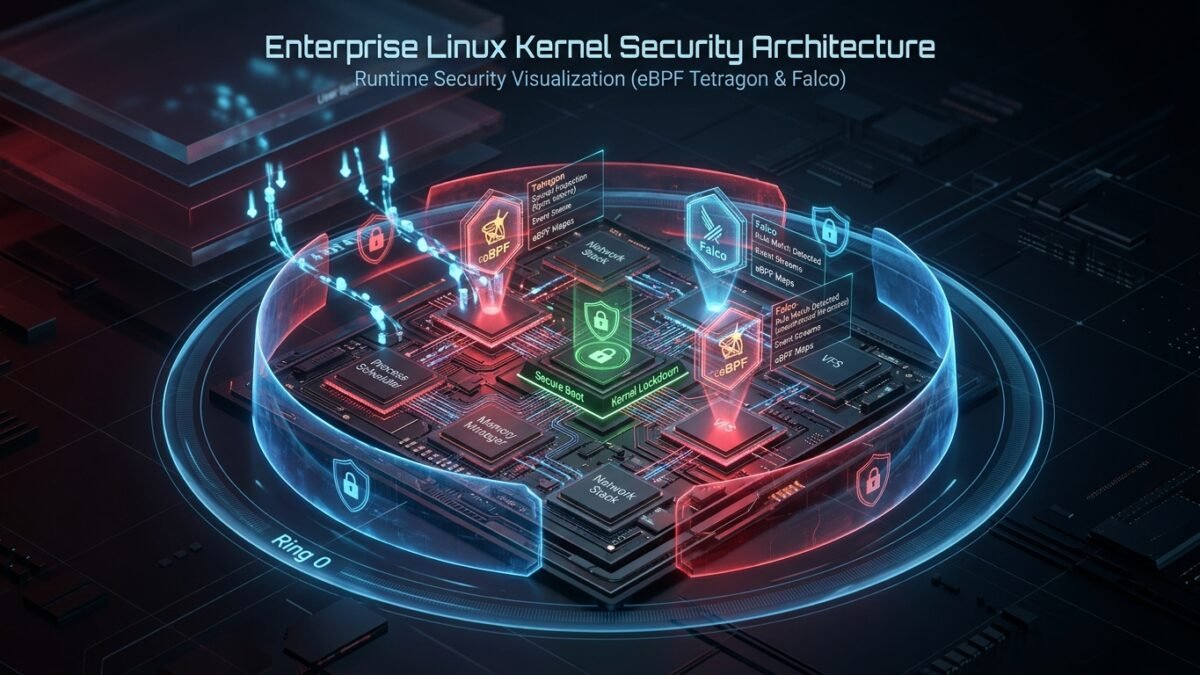
Legacy Linux host security relied entirely on user-space daemons polling /proc or receiving streaming netlink events from the Linux Audit framework (auditd). In production Kubernetes clusters running thousands of high-throughput containers, auditd imposes a crippling 15% to 30% CPU penalty, drops critical syscall events under burst traffic, and remains vulnerable to kernel-space blind spots. Even worse, user-space detection tools cannot prevent zero-day lateral movement—they only alert after the reverse shell has already connected. Extended Berkeley Packet Filter (eBPF) transforms Linux runtime defense from reactive post-compromise log auditing into proactive, in-kernel observability and autonomous process termination. In this architectural guide, we dissect how to build a production eBPF runtime security pipeline using Cilium Tetragon for in-kernel execution filtering and Falco for behavioral event streaming.
1. The Problem: The Collapse of User-Space Monitoring and auditd Under Scale
Linux runtime security tools historically operated outside the kernel, creating fundamental latency and performance bottlenecks that modern adversaries exploit during container breakout attacks. User-space log scrapers cannot keep pace with ephemeral container lifecycles and microsecond-level process spawns.
When high-concurrency containerized workloads handle thousands of transactions per second, traditional user-space audit mechanisms fail along three critical fault lines:
- Severe Syscall Interception Overhead: Every syscall evaluated by
auditdtriggers a context switch between user space and kernel space. Benchmarks under heavy I/O demonstrate CPU utilization spikes between 15% and 35%, forcing engineering teams to disable syscall auditing on high-traffic database and API nodes. - Buffer Exhaustion and Silent Event Dropping: Under burst conditions (e.g., automated CI/CD runs or brute-force scanning), the kernel audit ring buffer overflows. When
auditdfails to drain events fast enough, the kernel silently drops telemetry, leaving zero audit records of adversary actions. - Time-of-Check to Time-of-Use (TOCTOU) Exploits: Because user-space monitors inspect processes asynchronously after syscall completion, an adversary wielding an automated payload can execute malicious code, spawn a subprocess, and unlink the executable binary before the detection daemon even parses the telemetry.
| Architectural Dimension | Legacy Linux Audit (auditd) | Falco (Kernel Module / eBPF Probe) | Cilium Tetragon (LSM & eBPF Tracing) |
|---|---|---|---|
| Execution Layer | User space via Netlink socket | eBPF probe pushing to user-space engine | 100% In-kernel execution via eBPF kprobes/LSM |
| CPU Overhead (Production) | High (15% – 30% under heavy I/O) | Low (~2% – 4% average) | Ultra-Low (<1.5% with in-kernel filtering) |
| Enforcement Capability | Alerting only (No execution blocking) | Alerting only (Relies on external reaction engine) | Autonomous In-Kernel SIGKILL before return |
| Container Context Awareness | Poor (Raw PID/UID without K8s metadata) | Native (Enriched with Pod, Namespace, Labels) | Native (Kernel-level Cgroup & Pod mapping) |
| Minimum Kernel Requirement | Linux 2.6+ (Universal legacy support) | Linux 4.14+ (Modern eBPF) | Linux 5.4+ (Full LSM hooks require 5.8+) |
2. Architectural Blueprint: The Linux Kernel eBPF Telemetry Pipeline
The eBPF runtime architecture operates by attaching sandboxed, bytecode programs directly to kernel tracepoints, kprobes (kernel function entry), kretprobes (kernel function exit), and Linux Security Module (LSM) hooks without modifying the underlying kernel source code.
When an application executes a critical syscall—such as sys_execve, sys_connect, or sys_ptrace—the execution flow follows a hardened cryptographic pipeline:
- Hook Attachment: The eBPF verification engine validates the safety of the bytecode program during loading. The bytecode attaches directly to kernel probes or LSM BPF hooks (available natively in Linux kernels 5.8+ with BPF Type Format enabled).
- In-Kernel Filtering: Unlike legacy tools that dump all raw events to user space, eBPF programs filter telemetry inside kernel memory using high-speed eBPF BPF Maps. Irrelevant processes are discarded before leaving the kernel, reducing inter-layer context switching by up to 98%.
- Ring Buffer Transport: Matching security violations stream into a lockless
BPF_MAP_TYPE_RINGBUF. This shared-memory ring buffer streams structured JSON/Protobuf events directly to user-space collectors without locking overhead. - Synchronous In-Kernel SIGKILL: When configuring Cilium Tetragon with an LSM policy, the kernel does not simply emit an alert—it executes an immediate kernel-level
SIGKILLor returns-EPERM, killing the unauthorized process before the syscall completes.
3. Production Implementation: Deploying Cilium Tetragon with Helm
Deploying Cilium Tetragon across a production Kubernetes cluster requires configuring the Tetragon DaemonSet with persistent ring buffers, export filters, and proper Linux kernel capability grants.
Step 1: Verify Linux Kernel Compatibility and BPF Type Format (BTF)
Before deployment, confirm that your worker node operating system (Ubuntu 22.04 LTS, RHEL 9, Amazon Linux 2023, or Flatcar) provides kernel 5.4+ and native BTF support:
# Check running kernel version
uname -r

# Verify that BPF Type Format (BTF) is enabled in the kernel
ls -l /sys/kernel/btf/vmlinux

# Confirm BPF LSM support is compiled into the active kernel
cat /sys/kernel/security/lsm
Step 2: Deploy Tetragon via Helm with Production Resource Tuning
Deploy the official Tetragon Helm chart into the dedicated kube-system namespace with tuned ring buffer memory allocations:
# Add the Cilium official Helm repository
helm repo add cilium https://helm.cilium.io
helm repo update

# Install Tetragon with production export filters
helm install tetragon cilium/tetragon -n kube-system
  --set tetragon.exportAllow='{"event_type":["PROCESS_EXEC","PROCESS_EXIT","PROCESS_KPROBE"]}'
  --set tetragon.resources.requests.cpu="100m"
  --set tetragon.resources.requests.memory="256Mi"
  --set tetragon.resources.limits.cpu="1000m"
  --set tetragon.resources.limits.memory="1024Mi"
  --set tetragon.bpf.mapBufferSize=65536
Step 3: Verify Tetragon DaemonSet Health and Telemetry Streaming
# Confirm all Tetragon agent pods are running across worker nodes
kubectl get ds -n kube-system tetragon

# Stream live real-time process execution events from a worker node
kubectl exec -ti -n kube-system ds/tetragon -c tetragon -- tetra getevents -o compact
4. Deep Enforcement: Writing Tetragon TracingPolicies for In-Kernel Process Termination
Tetragon TracingPolicy CRDs define declarative kernel-level security rules that monitor specific kernel symbols and enforce actions such as telemetry capture or synchronous process termination via Sigkill.
Scenario 1: Blocking Reverse Shells and Unauthorized Interactive Binaries
Production container pods running microservices should never spawn interactive shells (/bin/bash, /bin/sh, nc, python). The following policy terminates any process attempting to execute a shell inside the production-workloads namespace instantly:
apiVersion: cilium.io/v1alpha1
kind: TracingPolicy
metadata:
  name: block-container-interactive-shells
  namespace: production-workloads
spec:
  kprobes:
    - call: "sys_execve"
      syscall: true
      args:
        - index: 0
          type: "string"
      selectors:
        - matchArgs:
            - index: 0
              operator: "Prefix"
              values:
                - "/bin/sh"
                - "/bin/bash"
                - "/usr/bin/nc"
                - "/usr/bin/python"
          matchNamespaces:
            - "production-workloads"
          matchActions:
            - action: Sigkill
Scenario 2: Preventing Sensitive File Exfiltration (/etc/shadow and Service Account Tokens)
Attackers who compromise a container attempt to steal the projected Kubernetes ServiceAccount token from /var/run/secrets/kubernetes.io/serviceaccount/token. The following policy monitors the security_file_open LSM hook and blocks read access from unauthorized binaries:
apiVersion: cilium.io/v1alpha1
kind: TracingPolicy
metadata:
  name: protect-service-account-tokens
spec:
  kprobes:
    - call: "security_file_open"
      syscall: false
      args:
        - index: 0
          type: "file"
      selectors:
        - matchArgs:
            - index: 0
              operator: "Postfix"
              values:
                - "/serviceaccount/token"
                - "/etc/shadow"
          matchBinaries:
            - operator: "NotIn"
              values:
                - "/usr/local/bin/app-binary"
          matchActions:
            - action: Sigkill
5. Falco Runtime Rule Engineering: Detecting Namespace Escapes and Privilege Escalation
Falco rules complement in-kernel process termination by analyzing behavioral patterns across the entire container infrastructure, forwarding enriched security alerts to SIEM platforms (Splunk, Elastic) or Slack webhooks.
Deploying Falco via Helm with Modern eBPF Driver
# Add Falcosecurity Helm repository
helm repo add falcosecurity https://falcosecurity.github.io/charts
helm repo update

# Install Falco utilizing the modern eBPF probe driver
helm install falco falcosecurity/falco -n falco --create-namespace
  --set driver.kind=modern_ebpf
  --set tty=true
  --set falco.json_output=true
  --set falco.priority=warning
Custom Production Falco Rule: Detecting Container Namespace Escapes (CVE-2024-21626 / runc)
Add the following custom rule into your Falco configuration to detect attempts by adversaries to access host namespaces via nsenter or suspicious /proc directory traversal:
# custom-falco-rules.yaml
- rule: Container Namespace Escape Attempt
  desc: Detects an attempt to join a host namespace or traverse /proc/1/ns from within a container
  condition: >
    spawned_process and container and
    (proc.name in (nsenter, unshare) or
     proc.cmdline contains "/proc/1/ns/" or
     proc.args contains "--target 1")
  output: >
    CRITICAL: Container namespace escape attempted!
    (user=%user.name user_id=%user.uid container_id=%container.id
    container_name=%container.name pod=%k8s.pod.name image=%container.image.repository
    cmdline=%proc.cmdline parent=%proc.pname)
  priority: CRITICAL
  tags: [security, container, mitre_privilege_escalation, T1611]
6. Production Troubleshooting & Kernel Diagnostics
| Error Symptom / Diagnostic Code | Root Cause | Investigation Command | Engineering Resolution |
|---|---|---|---|
BPF verifier rejected program (R1 invalid mem access) |
eBPF bytecode exceeded verifier complexity limit or accessed unvalidated pointer memory. | dmesg -T | grep -i bpf |
Update Tetragon/Falco chart to latest stable version; confirm kernel matches minimum BTF specifications. |
BTF not found in /sys/kernel/btf/vmlinux |
Worker node OS kernel compiled without CONFIG_DEBUG_INFO_BTF=y. |
ls -la /sys/kernel/btf/vmlinux |
Upgrade worker node base AMI to Ubuntu 22.04 LTS or Amazon Linux 2023 with modern kernel. |
Tetragon pod CrashLoopBackOff: failed to mount BPF filesystem |
Node lacks /sys/fs/bpf mount or container lacks CAP_SYS_ADMIN / CAP_BPF privileges. |
kubectl logs -n kube-system ds/tetragon -c tetragon |
Ensure host node mounts BPF filesystem via mount -t bpf bpf /sys/fs/bpf in node bootstrap script. |
Falco events dropping under high throughput |
Modern eBPF ring buffer size insufficient for cluster syscall density. | Inspect Falco metrics: falco_kernel_drops_total |
Increase driver.modern_ebpf.cpus_for_each_syscall_buffer to 2 or 4 in Helm configuration. |
7. Production Checklist & Architecture Recommendations
- Standardize on Kernel 5.8+: Mandate worker nodes running Linux kernel 5.8 or higher with BPF Type Format (BTF) and BPF LSM enabled to support in-kernel process termination.
- Combine Tetragon and Falco: Use Cilium Tetragon for low-latency, in-kernel blocking (
Sigkill) of obvious malicious binaries, and Falco for macro-level behavioral alerting and SIEM ingestion. - Integrate with Ingress Hardening: Pair host-level eBPF monitoring with edge ingress filtering by following our guide on Kubernetes Ingress Hardening with Cilium eBPF & Gateway API.
- Connect to Service Mesh Zero Trust: Ensure your node-level eBPF policies integrate seamlessly with application mutual TLS using Istio Ambient Mesh & Sidecarless mTLS.
- Harden Host Linux Identities: Restrict shell access on host nodes by configuring hardware keys as detailed in Enterprise Linux Identity: SSSD, AD Realm & FIDO2 Hardening.
8. Frequently Asked Questions (FAQ)
Q1: What is the primary operational difference between Cilium Tetragon and Falco?
While both tools leverage eBPF for kernel-level telemetry, Falco functions primarily as a behavioral detection engine that streams audit events to user-space collectors. Cilium Tetragon runs deep inside kernel LSM hooks and can synchronously terminate malicious processes via Sigkill before the syscall completes, preventing unauthorized execution in real time.
Q2: Does deploying eBPF runtime security require rebooting Kubernetes worker nodes?
No. eBPF bytecode programs are loaded dynamically into the running Linux kernel using the bpf() syscall. Neither kernel updates nor node reboots are required to deploy, update, or remove Tetragon or Falco DaemonSets.
Q3: Why does auditd consume significantly more CPU than eBPF?
The legacy Linux audit system (auditd) requires synchronous context switching between user space and kernel space for every evaluated syscall over netlink sockets. eBPF programs filter events directly within kernel memory using BPF Maps, discarding benign traffic before it ever leaves the kernel.
Q4: Can an attacker running inside a privileged container disable host eBPF programs?
If an attacker achieves root access inside a fully privileged container with CAP_SYS_ADMIN or CAP_BPF, they can theoretically interact with host eBPF maps. To mitigate this, enforce Kubernetes Admission Controllers that disallow privileged containers and restrict host namespace sharing across all untrusted workloads.
{
“@context”: “https://schema.org”,
“@type”: “FAQPage”,
“mainEntity”: [
{
“@type”: “Question”,
“name”: “What is the primary operational difference between Cilium Tetragon and Falco?”,
“acceptedAnswer”: {
“@type”: “Answer”,
“text”: “While both tools leverage eBPF for kernel-level telemetry, Falco functions primarily as a behavioral detection engine that streams audit events to user-space collectors. Cilium Tetragon runs deep inside kernel LSM hooks and can synchronously terminate malicious processes via Sigkill before the syscall completes, preventing unauthorized execution in real time.”
}
},
{
“@type”: “Question”,
“name”: “Does deploying eBPF runtime security require rebooting Kubernetes worker nodes?”,
“acceptedAnswer”: {
“@type”: “Answer”,
“text”: “No. eBPF bytecode programs are loaded dynamically into the running Linux kernel using the bpf() syscall. Neither kernel updates nor node reboots are required to deploy, update, or remove Tetragon or Falco DaemonSets.”
}
},
{
“@type”: “Question”,
“name”: “Why does auditd consume significantly more CPU than eBPF?”,
“acceptedAnswer”: {
“@type”: “Answer”,
“text”: “The legacy Linux audit system (auditd) requires synchronous context switching between user space and kernel space for every evaluated syscall over netlink sockets. eBPF programs filter events directly within kernel memory using BPF Maps, discarding benign traffic before it ever leaves the kernel.”
}
},
{
“@type”: “Question”,
“name”: “Can an attacker running inside a privileged container disable host eBPF programs?”,
“acceptedAnswer”: {
“@type”: “Answer”,
“text”: “If an attacker achieves root access inside a fully privileged container with CAP_SYS_ADMIN or CAP_BPF, they can theoretically interact with host eBPF maps. To mitigate this, enforce Kubernetes Admission Controllers that disallow privileged containers and restrict host namespace sharing across all untrusted workloads.”
}
}
]
}
Authoritative Technical References & Implementation Guides
Standards, official architecture centers, and verified documentation for this production workload: