Cloud Knowledge

Your Go-To Hub for Cloud Solutions & Insights

Advertisement

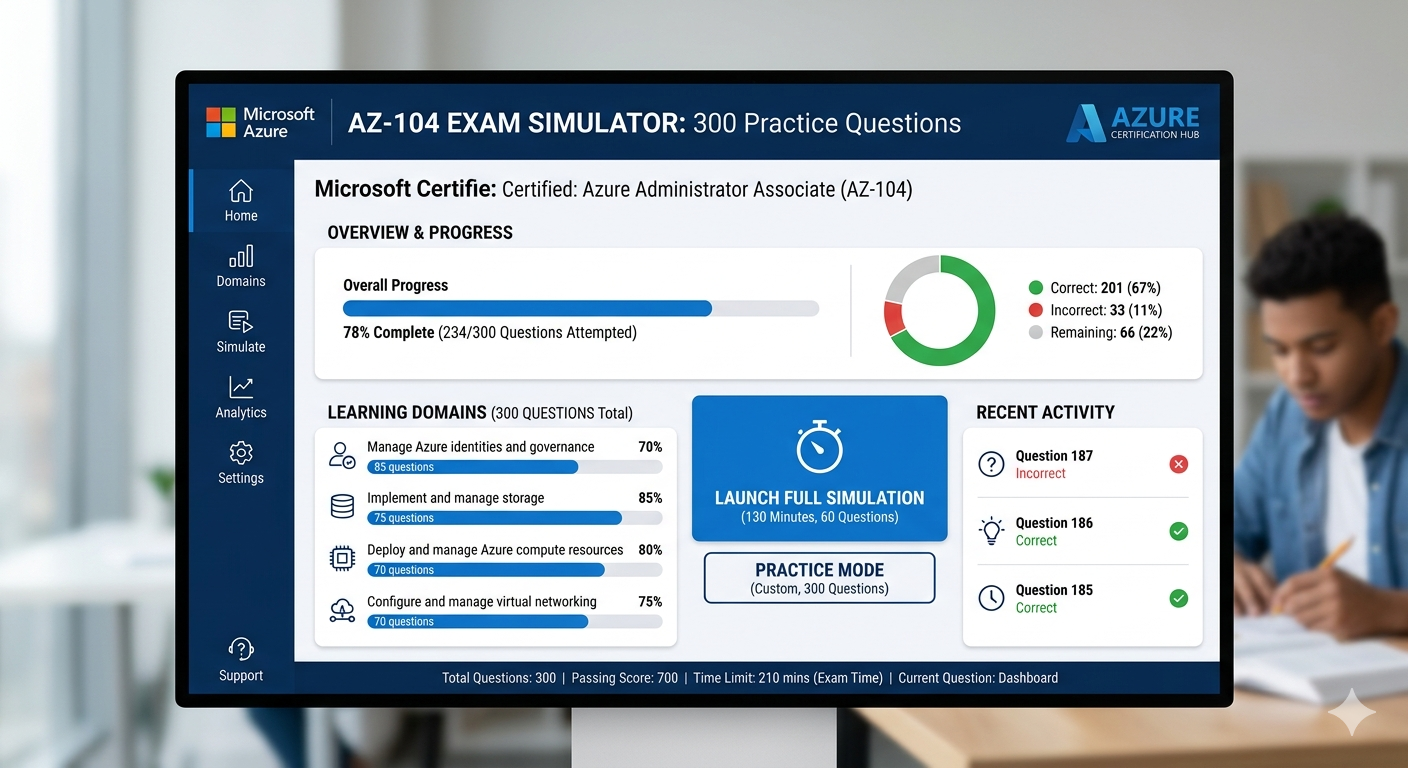
AZ-104 Exam Simulator (300 Questions) – Free Azure Administrator Practice Test

AZ-104 Exam Simulator
AZ-104 Azure Administrator - 300 Questions & Answers

AZ-104 Azure Administrator – 300 Questions & Answers

Section 1: Azure Identity & Access Management

Q1. What is Azure Active Directory (Azure AD)?
Azure AD is Microsoft’s cloud-based identity and access management service used for authentication and authorization to access resources like Microsoft 365 and Azure.
Q2. Difference between Azure AD and Windows AD?
Windows AD is on-premises and uses LDAP/Kerberos, while Azure AD is cloud-based and uses modern protocols like OAuth, SAML, and OpenID Connect.
Q3. What is Azure AD Connect?
Azure AD Connect synchronizes on-premises Active Directory identities to Azure AD, enabling hybrid identity and SSO.
Q4. What are Azure AD Roles?
Roles define permissions in Azure AD, such as Global Admin, User Admin, and Security Admin.
Q5. What is RBAC?
RBAC controls access to Azure resources by assigning roles to users at specific scopes.
Q6. Built-in RBAC roles?
Owner, Contributor, Reader, and User Access Administrator.
Q7. What is a Service Principal?
An identity used by applications to access Azure resources securely.
Q8. What is Managed Identity?
An Azure-managed identity that eliminates credential management for applications.
Q9. What is MFA?
Multi-factor authentication requires multiple verification methods to enhance security.
Q10. What is Conditional Access?
Policies that enforce access controls based on conditions like location, device, or risk.
Q11. What is Azure AD B2B?
Allows external users to access your resources using their own identity.
Q12. What is Azure AD B2C?
Identity solution for customer-facing applications with social logins.
Q13. What is PIM?
Privileged Identity Management provides just-in-time admin access.
Q14. What is Identity Protection?
Detects risky sign-ins using machine learning.
Q15. What is Azure AD Tenant?
A dedicated instance of Azure AD for an organization.
Q16. Authentication vs Authorization?
Authentication verifies identity; Authorization defines permissions.
Q17. What are Azure AD Groups?
Used to manage access for multiple users.
Q18. Dynamic Groups?
Automatically assign users based on attributes.
Q19. What is App Registration?
Registers applications in Azure AD for authentication.
Q20. What is SSPR?
Self-Service Password Reset allows users to reset passwords independently.
Q21. What is Access Review?
Periodic review of user access to ensure least privilege.
Q22. What is Guest User?
External user invited into Azure AD.
Q23. What is Azure AD DS?
Managed domain services in Azure.
Q24. Free vs Premium Azure AD?
Premium includes Conditional Access, PIM, Identity Protection.
Q25. What is Entitlement Management?
Automates access packages and approval workflows.

Section 2: Azure Virtual Machines

Q26. What is an Azure Virtual Machine (VM)?
An Azure VM is an on-demand, scalable computing resource that allows you to run applications without managing physical hardware. It is part of Infrastructure as a Service (IaaS).
Q27. What are VM Size families in Azure?
VM families include General Purpose (B, D), Compute Optimized (F), Memory Optimized (E, M), Storage Optimized (L), GPU (N), and HPC (H).
Q28. What is an Availability Set?
A logical grouping of VMs to ensure high availability by distributing them across fault domains and update domains.
Q29. What is an Availability Zone?
Physically separate datacenters within a region that provide high availability and fault isolation.
Q30. Difference between Availability Set and Availability Zone?
Availability Sets protect within a datacenter (99.95% SLA), while Zones protect across datacenters (99.99% SLA).
Q31. What is VM Scale Set (VMSS)?
A group of identical VMs that automatically scale based on demand.
Q32. Difference between stopping vs deallocating a VM?
Deallocating stops billing for compute resources, while stopping without deallocation still incurs charges.
Q33. What are VM disks in Azure?
VM disks include OS disk, temporary disk, and data disks used for storage.
Q34. What is Azure Managed Disk?
Managed disks are Azure-managed storage that removes the need to manage storage accounts manually.
Q35. What is VM Disk Encryption?
Encrypts VM disks using BitLocker (Windows) or dm-crypt (Linux) with keys stored in Azure Key Vault.
Q36. How to connect to a Windows VM?
Using Remote Desktop Protocol (RDP) on port 3389 or Azure Bastion.
Q37. How to connect to a Linux VM?
Using SSH on port 22 or Azure Bastion.
Q38. What is Azure Bastion?
A managed service that provides secure RDP/SSH access via browser without exposing ports.
Q39. What is Just-In-Time VM Access?
Temporarily opens VM access ports only when needed to enhance security.
Q40. What is a VM Snapshot?
A point-in-time copy of a disk used for backup or recovery.
Q41. What is Azure VM Backup?
A service that backs up VMs using Recovery Services Vault with retention policies.
Q42. What is Azure Site Recovery (ASR)?
Provides disaster recovery by replicating VMs to another region.
Q43. What is Custom Script Extension?
Runs scripts on VMs after deployment for configuration tasks.
Q44. What is Azure Serial Console?
A text-based console for troubleshooting VMs when normal access fails.
Q45. What is Proximity Placement Group?
Ensures VMs are physically close to reduce latency.
Q46. What are Azure Spot VMs?
Low-cost VMs using unused Azure capacity, but can be evicted anytime.
Q47. What are VM Extensions?
Tools for automation and configuration like monitoring agents and scripts.
Q48. What is Azure Hybrid Benefit?
Allows use of existing licenses (Windows/SQL) to reduce Azure costs.
Q49. Generalized vs Specialized VM image?
Generalized removes machine-specific data; Specialized keeps it for cloning.
Q50. What is Azure VM Image Builder?
Automates creation of custom VM images using templates.

Section 3: Azure Networking

Q51. What is an Azure Virtual Network (VNet)?
A VNet is a logically isolated network in Azure that enables resources to securely communicate with each other, the internet, and on-premises networks.
Q52. What is a Subnet in Azure?
A subnet is a segment of a VNet's IP address range used to organize and secure resources.
Q53. What is VNet Peering?
VNet Peering connects two VNets, allowing resources to communicate using private IP addresses over Azure backbone.
Q54. What is an NSG (Network Security Group)?
NSG controls inbound and outbound traffic using security rules based on IP, port, and protocol.
Q55. What is Azure Load Balancer?
A Layer 4 load balancer that distributes traffic across backend VMs using TCP/UDP.
Q56. What is Azure Application Gateway?
A Layer 7 load balancer with Web Application Firewall (WAF) for HTTP/HTTPS traffic routing.
Q57. What is Azure Traffic Manager?
A DNS-based global load balancer that routes traffic based on performance, priority, or geographic rules.
Q58. What is Azure Front Door?
A global HTTP/HTTPS load balancer with CDN and WAF capabilities for high-performance web apps.
Q59. What is Azure DNS?
A service that hosts DNS domains and provides name resolution using Microsoft infrastructure.
Q60. What is a Private DNS Zone?
Provides DNS resolution within VNets without requiring custom DNS servers.
Q61. What is Azure VPN Gateway?
A service that connects on-premises networks to Azure VNets using encrypted tunnels over the internet.
Q62. What is Azure ExpressRoute?
A private connection between on-premises infrastructure and Azure, bypassing the public internet.
Q63. VPN Gateway vs ExpressRoute?
VPN uses internet with encryption, while ExpressRoute uses private dedicated connection with higher performance.
Q64. What is Azure Private Link?
Provides private connectivity to Azure services using private IP addresses within a VNet.
Q65. What is a Private Endpoint?
A network interface that connects a service privately to your VNet using Azure Private Link.
Q66. What is a Service Endpoint?
Extends VNet identity to Azure services while still using public endpoints.
Q67. What is Azure Firewall?
A managed firewall service providing stateful inspection and threat filtering.
Q68. What is Azure DDoS Protection?
Protects applications from Distributed Denial-of-Service attacks.
Q69. Why is Azure Bastion important?
Provides secure VM access without exposing RDP/SSH ports to the internet.
Q70. What is Network Watcher?
Provides monitoring and diagnostic tools for Azure networking.
Q71. What is NSG Flow Logs?
Captures traffic information passing through NSGs for analysis.
Q72. What are User Defined Routes (UDR)?
Custom routes that control how traffic flows within a network.
Q73. What is Azure NAT Gateway?
Provides outbound internet connectivity using static public IP addresses.
Q74. Public IP vs Private IP?
Public IP is internet-accessible; Private IP is internal within VNet.
Q75. What is NIC in Azure?
A Network Interface Card connects a VM to a VNet.
Q76. What is Azure Virtual WAN?
A networking service that integrates connectivity, routing, and security.
Q77. What is GatewaySubnet?
A dedicated subnet required for VPN or ExpressRoute gateway deployment.
Q78. What is Connection Troubleshoot?
A tool in Network Watcher to diagnose connectivity issues between resources.
Q79. What is Azure CDN?
Delivers content from edge locations to reduce latency.
Q80. Basic vs Standard Load Balancer?
Standard offers better security, scaling, and availability compared to Basic.

Section 4: Azure Storage

Q81. What are the main Azure Storage services?
Blob Storage (object storage), File Storage (file shares), Queue Storage (messaging), and Table Storage (NoSQL key-value store).
Q82. What is an Azure Storage Account?
A storage account is a unique namespace in Azure that provides access to storage services like blobs, files, queues, and tables.
Q83. What are Storage Account types?
General Purpose v2 (recommended), General Purpose v1, Blob Storage, BlockBlobStorage, and FileStorage.
Q84. What are Blob Storage access tiers?
Hot (frequent access), Cool (infrequent access), Cold (rare access), and Archive (offline storage).
Q85. What is Blob rehydration?
The process of moving data from Archive tier back to Hot or Cool for access.
Q86. What is lifecycle management?
Automates data movement between tiers or deletion based on rules.
Q87. Block Blob vs Page Blob vs Append Blob?
Block Blob for general data, Append Blob for logs, Page Blob for VM disks.
Q88. What is Azure File Storage?
Provides managed file shares accessible via SMB or NFS protocols.
Q89. What is Azure File Sync?
Syncs on-premises file servers with Azure File Storage.
Q90. What is a Shared Access Signature (SAS)?
A token that provides limited access to storage resources for a defined time.
Q91. What is Azure Storage Encryption?
Encrypts data at rest using AES-256 with Microsoft-managed or customer-managed keys.
Q92. What are replication options?
LRS, ZRS, GRS, and GZRS provide different levels of redundancy.
Q93. GRS vs RA-GRS?
GRS provides backup copy; RA-GRS allows read access to secondary region.
Q94. What is Azure Data Lake Gen2?
Blob storage with hierarchical namespace optimized for big data analytics.
Q95. What is Queue Storage?
Stores messages for asynchronous communication between components.
Q96. What is Table Storage?
A NoSQL key-value store for structured data.
Q97. What is Immutable Blob Storage?
Stores data in write-once-read-many (WORM) state for compliance.
Q98. What is Soft Delete?
Allows recovery of deleted data within a retention period.
Q99. What is Azure Storage Explorer?
A GUI tool to manage Azure storage data.
Q100. What is Object Replication?
Copies blobs between storage accounts asynchronously.
Q101. What is Storage Firewall?
Restricts access to storage account by IP or VNet rules.
Q102. What is Blob Versioning?
Maintains previous versions of blobs for recovery.
Q103. What is Azure Premium Storage?
High-performance SSD-based storage for low latency workloads.
Q104. What are Storage Account keys?
Access keys that provide full control; should be secured and rotated regularly.
Q105. What is Static Website Hosting?
Allows hosting static websites using Azure Blob Storage.

Section 5: Azure Monitor & Logging

Q106. What is Azure Monitor?
Azure Monitor is a service that collects, analyzes, and acts on telemetry data from Azure and on-premises environments.
Q107. Metrics vs Logs?
Metrics are numerical time-series data for real-time monitoring, while Logs are detailed records analyzed using KQL.
Q108. What is Log Analytics Workspace?
A centralized workspace where logs from multiple Azure resources are stored and queried.
Q109. What is KQL?
Kusto Query Language is used to query and analyze log data in Azure Monitor.
Q110. What is Azure Activity Log?
Tracks management operations like resource creation, deletion, and updates.
Q111. What are Diagnostic Settings?
Configure where logs and metrics are sent, such as Log Analytics, Storage, or Event Hub.
Q112. What are Azure Alerts?
Notifications triggered based on defined conditions in metrics or logs.
Q113. What is an Action Group?
Defines actions taken when an alert is triggered, such as email or webhook.
Q114. What is Application Insights?
Monitors application performance and detects issues.
Q115. What is Azure Service Health?
Provides information about Azure service outages and planned maintenance.
Q116. What is Azure Resource Health?
Shows the health status of individual Azure resources.
Q117. What are Workbooks?
Interactive reports combining metrics, logs, and visuals.
Q118. What are Dashboards?
Customizable views in Azure Portal to monitor resources.
Q119. Azure Monitor vs Microsoft Sentinel?
Azure Monitor focuses on performance monitoring, while Sentinel is a SIEM/SOAR security solution.
Q120. Metric Alerts vs Log Alerts?
Metric Alerts are real-time thresholds; Log Alerts are based on query results.
Q121. What is Azure Monitor Agent?
A unified agent for collecting logs and performance data from VMs.
Q122. What is VM Insights?
Provides performance monitoring and dependency mapping for VMs.
Q123. What is Container Insights?
Monitors Kubernetes clusters and container workloads.
Q124. What is a Data Collection Rule (DCR)?
Defines what data to collect and where to send it.
Q125. What is AMPLS?
Azure Monitor Private Link Scope enables private connectivity for monitoring data.

Section 6: Azure Resource Management

Q126. What is Azure Resource Manager (ARM)?
ARM is the management layer that allows you to deploy, manage, and organize Azure resources using a unified API.
Q127. What is an ARM Template?
A JSON file used to define and deploy Azure infrastructure as code in a declarative way.
Q128. What is Bicep?
A domain-specific language that simplifies ARM template creation with cleaner syntax and better readability.
Q129. What is a Resource Group?
A logical container for grouping related Azure resources that share the same lifecycle.
Q130. What is an Azure Subscription?
A billing and management boundary where Azure resources are created and managed.
Q131. What are Management Groups?
A hierarchy used to organize subscriptions and apply governance like policies and RBAC at scale.
Q132. What is Azure Policy?
A service used to enforce rules and ensure compliance of Azure resources.
Q133. What is a Policy Initiative?
A collection of policies grouped together to achieve a broader compliance objective.
Q134. What is Azure Blueprints?
A way to define and deploy a repeatable set of resources, policies, and configurations.
Q135. What is Resource Locking?
Prevents accidental deletion or modification of resources using ReadOnly or CanNotDelete locks.
Q136. What are Azure Tags?
Key-value pairs used to organize and manage resources for cost tracking and governance.
Q137. Azure Policy vs RBAC?
RBAC controls access (who can do what), while Policy enforces rules (what can be done).
Q138. What is Deployment Stack?
A feature to manage a group of resources as a single unit with lifecycle and protection controls.
Q139. What is Azure Cloud Shell?
A browser-based command-line environment for managing Azure using CLI or PowerShell.
Q140. What is Azure CLI?
A cross-platform command-line tool used to manage Azure resources using commands.
Q141. What is Azure PowerShell?
A set of cmdlets used to manage Azure resources through PowerShell scripting.
Q142. What is Azure Portal?
A web-based interface for managing Azure services and resources.
Q143. What is Cost Management?
A service to monitor, analyze, and optimize Azure spending.
Q144. What are Azure Reservations?
Prepaid plans for Azure services that provide cost savings for long-term usage.
Q145. What is Azure Pricing Calculator?
A tool to estimate Azure costs before deployment.
Q146. What is Azure Advisor?
Provides recommendations for improving performance, security, cost, and reliability.
Q147. What is Naming Convention?
A standardized naming pattern for resources to improve management and clarity.
Q148. What is Azure Landing Zone?
A pre-configured environment based on best practices for scalable Azure deployments.
Q149. What is Cloud Adoption Framework (CAF)?
Microsoft guidance for planning, deploying, and managing cloud environments effectively.
Q150. What is Azure Managed Application?
A solution where providers manage deployed resources on behalf of customers.

Section 7: Azure App Services & PaaS

Q151. What is Azure App Service?
A fully managed PaaS platform to host web apps, APIs, and mobile backends without managing infrastructure.
Q152. What is an App Service Plan?
Defines compute resources (CPU, RAM, OS) for hosting App Service applications.
Q153. What is Auto-Scaling in App Service?
Automatically scales instances based on load conditions like CPU or requests.
Q154. What are Deployment Slots?
Separate environments for testing and staging before swapping into production without downtime.
Q155. What is VNet Integration in App Service?
Allows App Service to securely access resources inside a Virtual Network.
Q156. What is App Service Environment (ASE)?
A fully isolated environment for running App Services inside a VNet with high security.
Q157. What is Azure Functions?
A serverless compute service that runs code in response to events.
Q158. Consumption vs Premium Plan in Azure Functions?
Consumption is event-based and cost-efficient with cold starts; Premium eliminates cold starts and offers more control.
Q159. What is Azure Logic Apps?
A workflow automation service that integrates apps and services using connectors.
Q160. What is Azure API Management?
A service to publish, secure, and monitor APIs with features like authentication and rate limiting.
Q161. What is Azure Container Instances (ACI)?
A service to run containers without managing servers or orchestration.
Q162. What is Azure Kubernetes Service (AKS)?
A managed Kubernetes service for deploying and managing containerized applications.
Q163. What is Azure Container Registry (ACR)?
A private Docker registry for storing and managing container images.
Q164. What is Azure Static Web Apps?
A service for hosting static websites with integrated CI/CD and serverless APIs.
Q165. What is Azure App Configuration?
A centralized service for managing application settings and feature flags.
Q166. What is Azure Cache for Redis?
A high-performance in-memory cache for improving application speed.
Q167. What is Azure Service Bus?
A messaging service for reliable communication between applications.
Q168. What is Azure Event Hub?
A big data streaming platform for ingesting large volumes of events.
Q169. What is Azure Event Grid?
An event routing service for building event-driven architectures.
Q170. What is Azure Notification Hubs?
A service to send push notifications to mobile devices at scale.
Q171. What is Azure Cognitive Services?
Pre-built AI services for vision, speech, language, and decision-making.
Q172. What is Azure DevOps?
A set of tools for software development lifecycle including CI/CD, repos, and boards.
Q173. What is Application Gateway WAF?
Provides web application protection against common attacks using OWASP rules.
Q174. What is Azure Spring Apps?
A managed platform for deploying Spring Boot applications.
Q175. What is Web Application Firewall (WAF)?
Protects web applications from threats like SQL injection and cross-site scripting.

Section 8: Azure Security

Q176. What is Microsoft Defender for Cloud?
A unified security management and threat protection service that provides recommendations and detects threats across Azure and hybrid environments.
Q177. What is Secure Score?
A metric that measures your security posture based on implemented security recommendations.
Q178. What is Azure Key Vault?
A service to securely store secrets, keys, and certificates with controlled access.
Q179. What can be stored in Key Vault?
Secrets (passwords, API keys), cryptographic keys, and certificates.
Q180. What is Microsoft Defender for Endpoint?
An endpoint security platform that provides threat detection and response for devices.
Q181. What is Microsoft Sentinel?
A cloud-native SIEM and SOAR solution for threat detection, investigation, and response.
Q182. What is Azure DDoS Protection?
Protects applications from Distributed Denial-of-Service attacks using adaptive mitigation.
Q183. What is Azure Information Protection?
A service for classifying and protecting sensitive data using labels and encryption.
Q184. What is Defender for Storage?
Detects suspicious activity and threats targeting Azure Storage accounts.
Q185. What is Just-In-Time (JIT) Access?
Provides temporary access to VMs by opening ports only when needed.
Q186. What is Defender for SQL?
Provides threat detection and vulnerability assessment for Azure SQL databases.
Q187. SIEM vs SOAR?
SIEM collects and analyzes logs; SOAR automates responses. Sentinel combines both.
Q188. What is Azure Security Benchmark?
A set of best practices and guidelines for securing Azure environments.
Q189. What is Azure Firewall?
A managed firewall service that filters network traffic using rules.
Q190. What is Network Security Group (NSG)?
Controls inbound and outbound traffic using security rules at subnet or NIC level.
Q191. What is Encryption at Rest?
Protects stored data using encryption keys.
Q192. What is Encryption in Transit?
Protects data while it is being transmitted using protocols like HTTPS.
Q193. What is Role-Based Access Control (RBAC)?
Controls access to resources based on roles assigned to users or groups.
Q194. What is Privileged Identity Management (PIM)?
Provides just-in-time privileged access to reduce risk of permanent admin roles.
Q195. What is Conditional Access?
Applies access policies based on user, device, location, or risk.
Q196. What is Identity Protection?
Detects risky sign-ins and compromised accounts using machine learning.
Q197. What is Azure Disk Encryption?
Encrypts VM disks using BitLocker or dm-crypt.
Q198. What is Managed Identity?
Provides identity for applications to access Azure resources securely without credentials.
Q199. What is Key Rotation?
Regularly updating encryption keys to maintain security.
Q200. What is Zero Trust Model?
A security model that assumes no trust and verifies every access request.

Section 9: Backup & Disaster Recovery

Q201. What is Azure Backup?
A service that provides simple, secure, and cost-effective backup for Azure VMs, files, and databases.
Q202. What is a Recovery Services Vault?
A storage entity used to manage and store backup data and recovery points.
Q203. What is Azure Site Recovery (ASR)?
A disaster recovery service that replicates workloads to another region for failover.
Q204. Backup vs Disaster Recovery?
Backup protects data; Disaster Recovery ensures business continuity during failures.
Q205. What is RPO?
Recovery Point Objective defines how much data loss is acceptable.
Q206. What is RTO?
Recovery Time Objective defines how quickly systems must be restored.
Q207. What is Backup Policy?
Defines backup frequency and retention period.
Q208. What is Incremental Backup?
Backs up only changes since the last backup, saving storage and time.
Q209. What is Full Backup?
Captures all data at a specific point in time.
Q210. What is Differential Backup?
Backs up data changed since the last full backup.
Q211. What is Geo-Redundant Storage (GRS)?
Replicates backup data to a secondary region for durability.
Q212. What is Soft Delete in Backup?
Retains deleted backup data for recovery within a retention period.
Q213. What is Cross-Region Restore?
Allows restoring backups from a secondary region.
Q214. What is Application-Consistent Backup?
Ensures data consistency by coordinating with applications during backup.
Q215. What is Crash-Consistent Backup?
Captures data at a point without application coordination.
Q216. What is Azure Backup Vault?
A newer vault type for managing backups with enhanced security and scalability.
Q217. What is Failover in ASR?
Switching operations to a secondary site during failure.
Q218. What is Failback?
Returning operations to the primary site after recovery.
Q219. What is Planned Failover?
A controlled failover with minimal downtime.
Q220. What is Unplanned Failover?
Occurs during unexpected outages without preparation.

Section 11: Load Balancing & High Availability

Q241. What is High Availability?
The ability of a system to remain operational with minimal downtime, even during failures.
Q242. What is Fault Tolerance?
The ability of a system to continue functioning even when components fail.
Q243. What is Azure Load Balancer?
A Layer 4 load balancer that distributes traffic across virtual machines using TCP/UDP.
Q244. What is Azure Application Gateway?
A Layer 7 load balancer that routes HTTP/HTTPS traffic and provides WAF protection.
Q245. What is Azure Traffic Manager?
A DNS-based load balancer that distributes traffic across global endpoints.
Q246. What is Azure Front Door?
A global HTTP load balancer with CDN and WAF capabilities for web applications.
Q247. Load Balancer vs Application Gateway?
Load Balancer works at Layer 4; Application Gateway works at Layer 7 with advanced routing.
Q248. Traffic Manager vs Front Door?
Traffic Manager is DNS-based routing; Front Door provides real-time HTTP routing with acceleration.
Q249. What is Availability Set?
Ensures VMs are distributed across fault and update domains within a datacenter.
Q250. What is Availability Zone?
Physically separate datacenters within a region providing higher fault isolation.
Q251. What is SLA?
Service Level Agreement defines uptime guarantees provided by Azure.
Q252. What is VM Scale Set?
Automatically scales a group of identical VMs based on demand.
Q253. What is Autoscaling?
Automatically adjusts resource capacity based on workload.
Q254. What is Health Probe?
Checks the health of backend instances to ensure traffic is routed only to healthy resources.
Q255. What is Redundancy?
The duplication of resources to increase reliability and availability.
Q256. What is Geo-Redundancy?
Replicating resources across regions for disaster recovery.
Q257. What is Multi-Region Deployment?
Deploying applications across multiple regions for high availability and low latency.
Q258. What is Active-Active vs Active-Passive?
Active-Active uses multiple active instances; Active-Passive uses a standby instance for failover.
Q259. What is Failover Routing?
Redirects traffic to a secondary endpoint when the primary fails.
Q260. What is Zone-Redundant Service?
A service replicated across availability zones for high availability.

Section 12: Automation & DevOps

Q261. What is Azure Automation?
A service that automates cloud management tasks using runbooks and schedules.
Q262. What is a Runbook?
A script or workflow used to automate tasks in Azure Automation.
Q263. What is Azure DevOps?
A suite of tools for software development including CI/CD, repositories, and pipelines.
Q264. What is CI/CD?
Continuous Integration and Continuous Deployment automate code building, testing, and deployment.
Q265. What is Azure Pipeline?
A CI/CD pipeline used to build and deploy applications automatically.
Q266. What is Infrastructure as Code (IaC)?
Managing infrastructure using code like ARM templates or Bicep.
Q267. What is Azure CLI?
A command-line tool used to manage Azure resources.
Q268. What is Azure PowerShell?
A scripting tool using PowerShell cmdlets to manage Azure resources.
Q269. What is Git?
A version control system for tracking code changes.
Q270. What is GitHub?
A platform for hosting and managing Git repositories.
Q271. What is Azure Repos?
A service in Azure DevOps that provides Git repositories for source control.
Q272. What is Azure Artifacts?
A service for managing and sharing packages like NuGet, npm, and Maven.
Q273. What is Azure Boards?
A project management tool for tracking work items and tasks.
Q274. What is Azure Test Plans?
Provides tools for manual and exploratory testing.
Q275. What is Azure ARM Template Deployment?
Deploying infrastructure using ARM templates through automation.
Q276. What is Bicep Deployment?
Deploying Azure resources using Bicep files instead of JSON templates.
Q277. What is Azure Logic Apps?
A workflow automation service for integrating applications and services.
Q278. What is Azure Functions?
A serverless compute service that runs code on-demand.
Q279. What is Webhook?
A mechanism for triggering actions via HTTP callbacks.
Q280. What is Continuous Monitoring?
The practice of continuously observing application performance and logs.

Section 13: Azure SQL & Databases

Q281. What is Azure SQL Database?
A fully managed relational database service based on Microsoft SQL Server.
Q282. What is Azure SQL Managed Instance?
A managed database service that provides near 100% compatibility with SQL Server.
Q283. What is SQL Server on Azure VM?
A virtual machine running SQL Server that gives full control over the environment.
Q284. Azure SQL Database vs Managed Instance?
SQL Database is PaaS with limited control; Managed Instance offers more compatibility and control.
Q285. What is DTU?
Database Transaction Unit is a blended measure of CPU, memory, and I/O.
Q286. What is vCore model?
A pricing model based on CPU cores, memory, and storage for better flexibility.
Q287. What is Azure Cosmos DB?
A globally distributed NoSQL database service supporting multiple APIs.
Q288. What are Cosmos DB APIs?
Core SQL, MongoDB, Cassandra, Table, and Gremlin APIs.
Q289. What is Throughput in Cosmos DB?
Measured in RU/s (Request Units per second), defining performance capacity.
Q290. What is Partitioning in Cosmos DB?
Divides data across multiple servers for scalability and performance.
Q291. What is Azure Database for MySQL?
A managed MySQL database service in Azure.
Q292. What is Azure Database for PostgreSQL?
A managed PostgreSQL database service in Azure.
Q293. What is Backup in Azure SQL?
Automated backups that allow point-in-time restore.
Q294. What is Point-in-Time Restore?
Restores a database to a specific time within retention period.
Q295. What is Geo-Replication?
Replicates databases to another region for disaster recovery.
Q296. What is Failover Group?
Manages automatic failover of databases across regions.
Q297. What is Transparent Data Encryption (TDE)?
Encrypts database files at rest to protect data.
Q298. What is Dynamic Data Masking?
Hides sensitive data from unauthorized users.
Q299. What is Always Encrypted?
Encrypts sensitive data at the client side before storing in database.
Q300. What is Azure SQL Firewall?
Controls access to Azure SQL databases using IP rules and network restrictions.

Leave a Reply

Your email address will not be published. Required fields are marked *